


Posts
2361
Joined
3/4/2013
Location
Galveston, TX
US

Edited Date/Time
1/19/2021 6:03pm
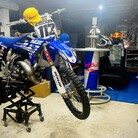
I see what I suspect is a wheel speed sensor

How can airbag work while riding on dakar rally bikes?
So many mysteries in this world.
Im not sure if we are as advanced as this in MX/SX yet, but this is how top end data-logging systems work.
Go to a WSB or Moto GP race, stand at the exit of the slowest corner and watch & listen to this happening- its amazing.
The Shop
Luxon 4-Post Bar Mounts
$189.95 - $239.95
Free shipping: VITALMX
DeCal Works Huge Plastic Inventory of UFO and Polisport kits.
But on soft surfaces? Especially those who change quickly and new lines develop?... I guess it is a bit of help sometimes but i can't see it being as huge advantage as it is on tarmac.
Maybe you guys can prove me wrong.
The airbag? That’s a little more complicated, but the first thing I would implement is: Does the rider go very quickly from upright to upside down: Fire!
It’s a pickup style speed sensor using the holes cut in the hub or hub spacer to determine wheel RPM.
They use the drive ratios through the engine and final drive to calculate what RPM the rear wheel should be turning at any given engine RPM (assuming no slip at all). It does this by using engine RPM and the gear position sensor to dynamically calculate what the output shaft RPM should be. When traction decreases, the rear wheel slip value will go higher because the rear wheel RPM is not matching the same curve as the output shaft. There will be a setting in the ECU software that is dynamically monitoring the slip percentage. If the slip percentage increases higher than the setting threshold, the ECU would then automatically adjust the engine map to get the rear wheel slip back down to the desired level. All of this is happening within milliseconds.
The slip percentage setting for the ECU is changed for different track types. A slick, dry track would have a different setting than a tacky track with lots of traction. There were several factory bikes at H1 where you could see they were full throttle coming out of corners and the system was working perfectly by driving the bike forward without excessive slip or too much grip inducing the front end to come up. A byproduct of all this is that the suspension becomes much more predictable as it stays loaded exactly where they want it and handling improves.
It doesn't look like there's a front wheel speed sensor on the bike. And being only two wheels, the wheel speed changes front to rear in corners, more so than a four wheeled car with both wheels averaged, (though that could be mitigated with some steering angle and lean sensors) so maybe that's why they seem to be looking at engine RPM only.
If they aren’t using the output shaft RPM as an input, then they are relying solely on the rear wheel RPM data. In this scenario, if the ECU detects that the rear wheel is exceeding an angular acceleration greater than the predetermined threshold, it will make an adjustment to manage the wheel slip. What I mean by that is they have enough testing data to correlate sharp rises in rear wheel angular acceleration to “loss of traction / wheel slip”. Once the wheel starts accelerating faster than what is predicted, the software will make an adjustment to try and get it back into the acceptable limits. Each rider probably has a different setting that is honed in on through hours upon hours of test data.
me like fast
also make loud noise
Drag cars (door cars) run similar systems as well. They use driveshaft speed sensors along with a myriad of other data to control horsepower.
Pit Row
It’s my guess that wheel speed sensor is for data logging and nothing else. Even though the rule doesn’t specifically call out a rear wheel sensor, “electronic devices designed specifically for traction control are prohibited” seems broad enough to cover it.
Also, the next part of the rule banning electronic transmission of information should put to rest any crazy talk of GPS based traction control.
The bigger concern is that I don’t think the AMA tech team could even detect such a system is in place without having access to the ECU software and understanding of its architecture.
So in drag racing we use a very simple traction control based on time. We tell the control at X seconds in to the run we shouldn’t see over X rpm at the drive shaft, if we do it will cut fuel or ignition. And you just build a ramp until you find the limit.
Their control may look similar but at x% throttle we shouldn’t see more than x engine rpm.
Also, the GPS mapping is absurd for MX or SX. What if the rider hits a different rut next time around? No way the GPS can tell the difference between a few inches.
I could definitely see them monitor clutch slip % using that sensor. Even without the lever pulled in, the clutch still slips on whoops and big impacts. It’s designed this way to protect the transmission gears. This would be good data to have if you’re trying to optimize clutch performance.
Post a reply to: Jets Honda rear wheel