



Posts
269
Joined
6/8/2016
Location
Park City, UT
US

Edited Date/Time
1/24/2017 7:43pm
There have been many theories on what actually caused Kenny’s crash. Did he make a mistake? Was there a kicker on the jump? Was there a problem with his setup? Was there a problem with the bike itself? Was it all of the above? I suspect Kenny himself is replaying the crash over and over in his mind and trying to understand exactly what happened.
So what did happen? I've provided a frame-by-frame sequence of the key moments of the event. These photos provide a great deal of insight into what likely caused Kenny's ultimate loss of control and crash as an end result.
DISCLAIMER: I am not an expert in physics or motorcycle suspension, though I am an avid rider and enthusiast. I felt compelled to analyze this crash out of shear curiosity. How could one of the top riders in the world lose total control of their bike so quickly, when it appeared that no major unexpected event took place to cause such a catastrophic outcome.

FRAME 1: Kenny is jumping a bit too far into the base of the jump, as his rear tire and not yet made contact with the ground as evident by the full travel remaining on his rear shock. The arrow to the left shows the chosen rut; and the photo is not clear enough to determine if there is any kicker in the dirt surface.

FRAME 2: The bike makes contact with the ground in this frame, as shown by the suspension starting to compress. Kenny’s technique and balance appears to be excellent.

FRAME 3: The rear suspension is now fully compressed for the 1st time right at the bottom of the base of the jump. His front forks still have travel/dampening remaining. Kenny is balanced with his legs at almost full extension. Everything looks normal.
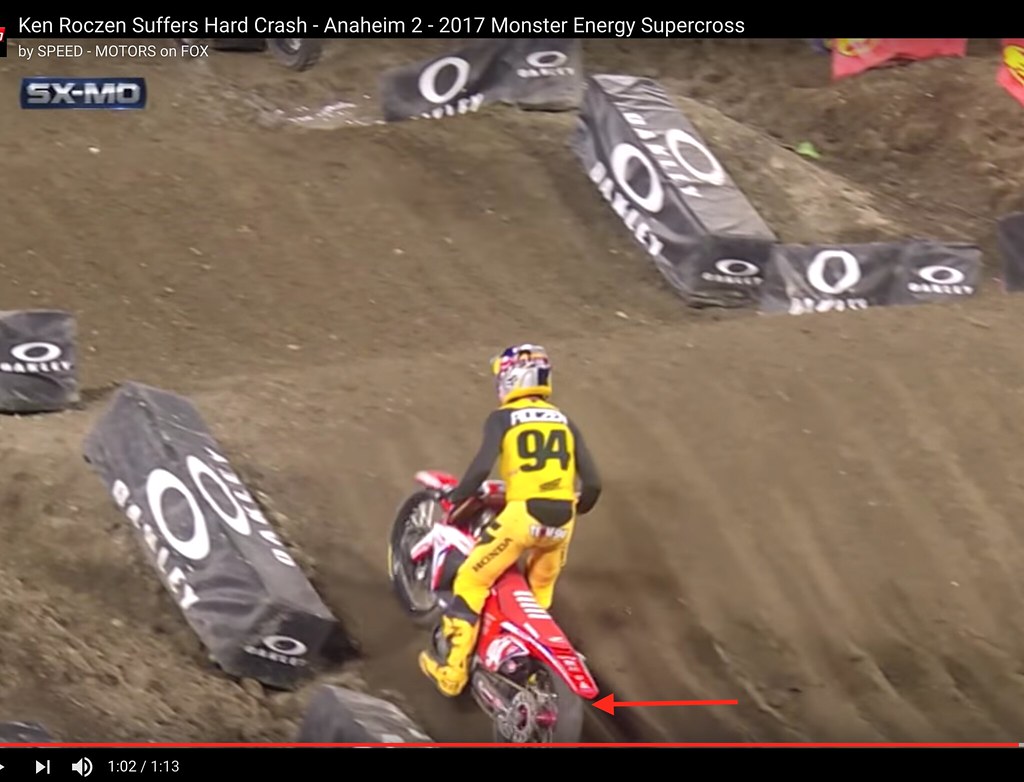
FRAME 4: The bike is almost 1/2 way up the face (Measured by the center of the bike). The rear shock of the bike looks like it’s fully compressed with little to no dampening remaining. The forks look to be mostly compressed as well, although it appears there may be some travel remaining, but it’s hard to be sure. Again, Kenny seems to be in excellent position and is not seat bouncing.

FRAME 5: The rear tire of the bike is now about a little more than 1/2 way up the jump face, and the rear tire has begun to lose contact with the ground (Watch the video and you’ll see it happen). The only logical cause is that there was an uneven surface on the jump face, as we all know as a kicker. And as seen on this frame and the previous frame, it appears the shock had no remaining travel or dampening available to absorb the force of the kicker. At the speed the speed Kenny is traveling (30MPH?), even a small bump can cause a significant amount of force. Normally such forces are dampened by the shock, but in this case, there was no dampening seemingly available. This un-dampened energy needs to go somewhere, and instead of being absorb by the shock, all the energy deflects upwards (Imagine a pendulum) causing the entire rear of the bike to begin moving upward.
UPDATE: After reading the response from ML512 & Hank_thrill, it seems either one of both of their theories are more likely than my "kicker" theory. If the jump was cupped out, it would also lead to rear end leaving the face early. However, ML512's suggestion of "The combination of the bike's reaction and him standing forward and pushing through the face causes a bit more severe reaction. In my opinion, comparing this to a similar situation I've had, when you blow the shock through the stroke like this and push through on the jump face, you don't notice the energy release as early because you're pushing the bike forward and that initial front dive feels like you caused it with your stance." seems even more viable.
As for the front tire has left the face of the jump and the forks are now rebounding normally. Kenny has absorbed some of the force from the compression of the jump face as his knees are bent more than in previous frames. This is probably intentional to absorb some energy and remain lower.

FRAME 6: If you didn’t see it before, you do now. Kenny’s rear wheel is clearly in the air before he has reached the top of the jump face. His rear shock is beginning to extend back to regain travel (I am purposely not using the term rebound, as people often think rebound can exert some significant force on the bike and can cause a kick, it’s a myth. Rebound is a controlled movement with very little downward force relative to the forces a 220+ bike has in motion). As for Kenny’s position, notice how close is to his seat, the gap is closing. Kenny probably starts to feel something unexpected is happening, but this is a very normal occurrence as top riders have to compensate for such things all the time.

FRAME 7: The rear tire is again clearly off the ground and supported by the shock regaining travel. Kenny’s feet are on the pegs, but now the seat has made impact with his butt.

FRAME 8: While Kenny’s feet are still no the pegs, the rear of the bike and Kenny’s bottom and entire body have begun moving in an upward direction.

FRAME 9: Kenny’s entire body is being pushed farther away from the bike, and it’s likely not on purpose because his feet just lost connection with his pegs. It’s now becoming clear the upward force and impact with is ass was significant enough for Kenny’s lower body to lose control of the bike. The rear of the bike is now slightly higher than in the previous frame, but it appears the upward motion of the bike and its attitude is moving at a much slower rate than Kenny’s body. Kenny’s body seemingly has now absorbed the upward energy of the bike and arrested the affect of the kicker on the bike itself. Kenny is part of the pendulum effect too, he’s another one of the balls now holding all the energy.

FRAME 10: Kenny’s body continues to move farther away from the bike, his feet are well off the pegs and his arm and legs are at full extension. The rear of the bike and it’s attitude are no higher than int he previous frame. From the looks of it, his bike looks like it will no longer flip over or cartwheel forward.

FRAME 11: Now with his arms at absolute full extension, he looks to make one last attempt to save himself from crashing by pulling up on the bars. Once again the rear attitude of the bike is unchanged.

FRAME 12: Kenny’s lower body continues to move upward and is fully disconnected from the bike. He made the decision to get rid of the bike and pushed the bike down and away. Once again, the attitude of the rear of the bike is unchanged.

FRAME 13: Kenny now turns his attention to where he’s going to hit ground. He must realize that his trajectory puts him on path with hitting the face of the forthcoming jump.

FRAME 14: Both his arms are out ahead of him and his face heading straight into the dirt.

FRAME 15: He impacts the ground with his left arm on the upper side of the jump making the initial impact followed by his head and right arm.
href="https://www.flickr.com/photos/28442823@N04/32388074231/in/dateposted-pu…" title="16">
FRAME 16: He continues his impact with a rolling motion to the left, causing his left arm to bear a significant portion of the force while his right arm being saved from being crushed.
My current thoughts: It’s well known in aviation investigations, that a single event rarely causes a plane to crash. Catastrophic events usually require 3 things to go wrong, with the outcome likely being prevented if any 1 of the actions in the chain were prevented. In this case, it appears a sequence of events or problems did happen as well.
1. Kenny’s mistake was jumping to far into this section, which may have forced his suspension to use all travel.
2. The rear of the suspension appears to have no dampening remaining. Is this typical? Was Kenny just going too fast forcing the suspension to lose all available dampening? Was Kenny’s setup too soft? Could there have been something wrong with the shock itself? These are of course unknowns, but something I would certainly want to know if I was Kenny or Honda.
3. A kicker must have been encountered up the jump face. UPDATE: After feedback from ML512 and others, the more likely scenarios are likely (1.) the jump face was cupped out at the bottom, which would cause the rear wheel to lose contact with the jump early. (2.) A combination of the energy created by the bottoming of the suspension and Kenny's technique in driving the front end forward in attempt to stay low, would have caused the backend to become unweighted.
4. Kenny probably didn’t notice the kicker or cupping of the jump face and didn’t expect it to have such a dramatic effect.
Get well KRoc! The moto community hopes you have a full and speedy recovery as the series won’t be the same without you.
Youtube Video link: https://www.youtube.com/watch?v=2fBw7HzKe10
So what did happen? I've provided a frame-by-frame sequence of the key moments of the event. These photos provide a great deal of insight into what likely caused Kenny's ultimate loss of control and crash as an end result.
DISCLAIMER: I am not an expert in physics or motorcycle suspension, though I am an avid rider and enthusiast. I felt compelled to analyze this crash out of shear curiosity. How could one of the top riders in the world lose total control of their bike so quickly, when it appeared that no major unexpected event took place to cause such a catastrophic outcome.
FRAME 1: Kenny is jumping a bit too far into the base of the jump, as his rear tire and not yet made contact with the ground as evident by the full travel remaining on his rear shock. The arrow to the left shows the chosen rut; and the photo is not clear enough to determine if there is any kicker in the dirt surface.
FRAME 2: The bike makes contact with the ground in this frame, as shown by the suspension starting to compress. Kenny’s technique and balance appears to be excellent.
FRAME 3: The rear suspension is now fully compressed for the 1st time right at the bottom of the base of the jump. His front forks still have travel/dampening remaining. Kenny is balanced with his legs at almost full extension. Everything looks normal.
FRAME 4: The bike is almost 1/2 way up the face (Measured by the center of the bike). The rear shock of the bike looks like it’s fully compressed with little to no dampening remaining. The forks look to be mostly compressed as well, although it appears there may be some travel remaining, but it’s hard to be sure. Again, Kenny seems to be in excellent position and is not seat bouncing.
FRAME 5: The rear tire of the bike is now about a little more than 1/2 way up the jump face, and the rear tire has begun to lose contact with the ground (Watch the video and you’ll see it happen). The only logical cause is that there was an uneven surface on the jump face, as we all know as a kicker. And as seen on this frame and the previous frame, it appears the shock had no remaining travel or dampening available to absorb the force of the kicker. At the speed the speed Kenny is traveling (30MPH?), even a small bump can cause a significant amount of force. Normally such forces are dampened by the shock, but in this case, there was no dampening seemingly available. This un-dampened energy needs to go somewhere, and instead of being absorb by the shock, all the energy deflects upwards (Imagine a pendulum) causing the entire rear of the bike to begin moving upward.
UPDATE: After reading the response from ML512 & Hank_thrill, it seems either one of both of their theories are more likely than my "kicker" theory. If the jump was cupped out, it would also lead to rear end leaving the face early. However, ML512's suggestion of "The combination of the bike's reaction and him standing forward and pushing through the face causes a bit more severe reaction. In my opinion, comparing this to a similar situation I've had, when you blow the shock through the stroke like this and push through on the jump face, you don't notice the energy release as early because you're pushing the bike forward and that initial front dive feels like you caused it with your stance." seems even more viable.
As for the front tire has left the face of the jump and the forks are now rebounding normally. Kenny has absorbed some of the force from the compression of the jump face as his knees are bent more than in previous frames. This is probably intentional to absorb some energy and remain lower.
FRAME 6: If you didn’t see it before, you do now. Kenny’s rear wheel is clearly in the air before he has reached the top of the jump face. His rear shock is beginning to extend back to regain travel (I am purposely not using the term rebound, as people often think rebound can exert some significant force on the bike and can cause a kick, it’s a myth. Rebound is a controlled movement with very little downward force relative to the forces a 220+ bike has in motion). As for Kenny’s position, notice how close is to his seat, the gap is closing. Kenny probably starts to feel something unexpected is happening, but this is a very normal occurrence as top riders have to compensate for such things all the time.
FRAME 7: The rear tire is again clearly off the ground and supported by the shock regaining travel. Kenny’s feet are on the pegs, but now the seat has made impact with his butt.
FRAME 8: While Kenny’s feet are still no the pegs, the rear of the bike and Kenny’s bottom and entire body have begun moving in an upward direction.
FRAME 9: Kenny’s entire body is being pushed farther away from the bike, and it’s likely not on purpose because his feet just lost connection with his pegs. It’s now becoming clear the upward force and impact with is ass was significant enough for Kenny’s lower body to lose control of the bike. The rear of the bike is now slightly higher than in the previous frame, but it appears the upward motion of the bike and its attitude is moving at a much slower rate than Kenny’s body. Kenny’s body seemingly has now absorbed the upward energy of the bike and arrested the affect of the kicker on the bike itself. Kenny is part of the pendulum effect too, he’s another one of the balls now holding all the energy.
FRAME 10: Kenny’s body continues to move farther away from the bike, his feet are well off the pegs and his arm and legs are at full extension. The rear of the bike and it’s attitude are no higher than int he previous frame. From the looks of it, his bike looks like it will no longer flip over or cartwheel forward.
FRAME 11: Now with his arms at absolute full extension, he looks to make one last attempt to save himself from crashing by pulling up on the bars. Once again the rear attitude of the bike is unchanged.
FRAME 12: Kenny’s lower body continues to move upward and is fully disconnected from the bike. He made the decision to get rid of the bike and pushed the bike down and away. Once again, the attitude of the rear of the bike is unchanged.
FRAME 13: Kenny now turns his attention to where he’s going to hit ground. He must realize that his trajectory puts him on path with hitting the face of the forthcoming jump.
FRAME 14: Both his arms are out ahead of him and his face heading straight into the dirt.
FRAME 15: He impacts the ground with his left arm on the upper side of the jump making the initial impact followed by his head and right arm.
href="https://www.flickr.com/photos/28442823@N04/32388074231/in/dateposted-pu…" title="16">
FRAME 16: He continues his impact with a rolling motion to the left, causing his left arm to bear a significant portion of the force while his right arm being saved from being crushed.
My current thoughts: It’s well known in aviation investigations, that a single event rarely causes a plane to crash. Catastrophic events usually require 3 things to go wrong, with the outcome likely being prevented if any 1 of the actions in the chain were prevented. In this case, it appears a sequence of events or problems did happen as well.
1. Kenny’s mistake was jumping to far into this section, which may have forced his suspension to use all travel.
2. The rear of the suspension appears to have no dampening remaining. Is this typical? Was Kenny just going too fast forcing the suspension to lose all available dampening? Was Kenny’s setup too soft? Could there have been something wrong with the shock itself? These are of course unknowns, but something I would certainly want to know if I was Kenny or Honda.
3. A kicker must have been encountered up the jump face. UPDATE: After feedback from ML512 and others, the more likely scenarios are likely (1.) the jump face was cupped out at the bottom, which would cause the rear wheel to lose contact with the jump early. (2.) A combination of the energy created by the bottoming of the suspension and Kenny's technique in driving the front end forward in attempt to stay low, would have caused the backend to become unweighted.
4. Kenny probably didn’t notice the kicker or cupping of the jump face and didn’t expect it to have such a dramatic effect.
Get well KRoc! The moto community hopes you have a full and speedy recovery as the series won’t be the same without you.
Youtube Video link: https://www.youtube.com/watch?v=2fBw7HzKe10
Seems like the rain caused the jump to cup out and make the face of the jump a little like this image. He also seemed to push through the face of the jump probably to stay low. These are just a few of my own observations. Hard to tell though without a side shot of the take off.
The Shop
DeCal Works Huge Plastic Inventory of UFO and Polisport kits.
Free shipping: VITALMX
Luxon 4-Post Bar Mounts
$189.95 - $239.95
Pitch and Yaw.
"I'll dip in some info here that should hopefully help you understand what happened. At MEC, Ken overshot the first rhythm in this section, compressing the suspension heavily and causing it to pop weird for the next set, which he then cased after losing his pop, then endo-ing off the third...
Tonight, he landed a little deep off the first rhythm, into a rut, blowing the shock through the stroke right as the bike hit a very abrupt triple face (a few guys had similar bucks with the abruptness of this lip).
Another factor, in my opinion, on why the reaction was so severe is Ken typically likes softer settings (from what I've been told by both his prior teams) which could compound this reaction.
Lastly, the bike itself wouldn't have a "flaw" in my opinion. The linkage ratio on this bike has been modified to match up to a near equal value of the previous models (well within the range of what other manufactures use). Their shock travel/stroke length wasn't compromised with the change either."
A friend of mine in the suspension business had the following to say:
(begins)
"The crash is caused from the shock releasing a shitload of stored energy too quickly. Simple physics.
In the last few years the manufactures have adopted/switched over to a more automotive model on the rebound circuits. It means more rebound damping for short displacement high velocity movements at a cost of not controlling high displacements movements where the spring and chassis heavily store energy.
Turns the bike into a spring board when the rear is heavily loaded.
Sort of a no brainer and if you look back these spring board style crashes have been happening a lot more.
These types of scenarios turn riders into lawn darts, increasing the changes of neck and spine compression injuries, of which a helmet and neck brace offer no protection.
Most will just write it off as "that's motocross".
Bullshit."
(ends)
Pretty interesting commentary....
Pit Row
I've rewatched that wreck probably 20 times ( and I hate seeing it happen because of the out come ) but watched it because I was really curious to see what actually happened. I re-watched the entire race the night before last as I had it recorded. I saw guys struggle on that exact jump all night. From the middle of the jump , to the far left , it was kicking everyone. I'm about 99% sure that because the dirt was pretty moist underneath , it looked like the face was " cupped out " from the bottom to about half way up , and got worse as the night went on.
Basically , not small kickers in-bedded in the ruts , the shape of the jump itself over time just created a cupped out , kicker style type jump. And with kenny , at the speed his riding , and that specific line choice , it bit him , badly.
Great work on the original post TK.
Also for those who are saying that the shock/forks are fully compressed when he's taking off, blah blah blah... That's how every single dirtbike looks like when preloading a jump that is fairly steep.
KR crashed. He's injured now. That's all that we need to know.
Post a reply to: Anatomy of a crash - Roczen's A2 Season Ender