


Posts
266
Joined
2/9/2012
Location
USA

Edited Date/Time
1/25/2022 4:58pm
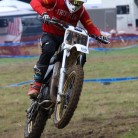
I had the opportunity a few months ago to get a 80 390 Husky that was in great condition. My dad raced 390's for most of the early 80's before switching to KTM's. According to him, this is the best bike ever made. Not sure I agree with that, but it is my favorite vintage bike. I raced it a couple times before I tore it down and went through it. It started out as an OR but I've changed a few things up to make it how I wanted.
I just wanted to share my favorite build so far.

It now has a CR tank, new Vintco Air Shox with Fox stickers, 45mm Marzocchi forks. I tried to make the bike look as period correct as I could, that's why I put the Fox stickers on the forks and shocks. I'm still waiting on a couple small things to finish it up, but it's about 95% finished.

I just wanted to share my favorite build so far.
It now has a CR tank, new Vintco Air Shox with Fox stickers, 45mm Marzocchi forks. I tried to make the bike look as period correct as I could, that's why I put the Fox stickers on the forks and shocks. I'm still waiting on a couple small things to finish it up, but it's about 95% finished.
The Shop
DeCal Works Huge Plastic Inventory of UFO and Polisport kits.
Luxon 4-Post Bar Mounts
$189.95 - $239.95
I love the original Swedish (REAL) Husky’s. I have 6 that we race,but no 390’s . You’ve done all great mods ,bike is beautiful. I cut all the loops off of all my ML framed bikes and have kept them too,just in case lol.
I’d be interested in how those Vintco Airs work as well. Again, great job !!!
I didn't find my 390 the easiest bike to turn. Eventually I'd just turn the bars and push it though with throttle. Great engine.
Are your shocks a little shorter than stock or are my eyes worse than the last time I looked at a 1980 Husky?
The shocks are 16", which is a little shorter than stock. When I got the bike from my Dad, he had some shorten the rear shocks so he could touch the ground. The few times I rode the bike it seemed to work good so when I purchased the Vintco shocks I stuck with the same length.
If so, then the bike it must have a very 'relaxed' front end, with the shorter shocks ( though, shorter shocks may have been the way Husky kicked the front end out further? )
Taking off the disc mounts? It's not going to make them Fox Forks (sorry, I'm Not a fan of mislabeling things) though, the Zokes probably work better. I have some Fox 44s, and have no illusions about how well old damper rod forks work. And, by leaving on the disc mounts, it gives you the option of having better brakes, if / when you take it outside of Vet / Vintage racing rules.
It certainly is a beautiful looking bike. And the 390 / 430 engines were wonderful things.
Pit Row
1. terrain-appropriate front tire
2. slide the fork stanchions up as far as possible in the triples, either to the limit imposed by travel or the bike feeling unstable on straights/oversteering in turns
3. you MUST sit as far forward as possible in turns, up at the seat/tank junction, or the bike won't initiate or finish turns well. In the first photo, you're sitting too far back. (Except for genuine sand tracks, where normal sand riding technique applies.)
Classic Huskys were the epitome of the old-school chassis approach, with more rearward weight bias and a lot of rake/trail, to help the rear hook up under power and to be as stable as possible down straightaways. This meant it turned better if you used the front brake hard and trail-braked into the corner to load the front end and deliberately compress the forks to reduce the rake--we didn't use low-speed compression damping for front-end holdup going into turns, we _wanted_ the front to dive going in, which was not fun on braking bumps.
Maico diverged a lot from this by using crank inertia for rear hookup, and much less rake for turning combined with leading front axles to retain more trail for straight-line stability. That's the model modern bikes derive from; the Japanese eventually caved in and stole it and Honda in particular refined it. It's just a different chassis dynamics and several years ago, Gary Jones told my brother that as he got older, he couldn't race vintage and modern bikes on the same day because two different sets of riding habits were required.
It also explains what Brad Lackey said back in 1975: "The secret to riding a Husky is you have to be in shape," i.e., in shape to move around on the bike as much as it requires, for the entire moto. Big Maicos were old-guy favorites then, got away with staying in the same spot a lot more.
About brake-sliding Huskys: the longer 79-80 250/390 forks went past the tipping point for torsional flex and don't turn in as positively even when compressed under heavy braking; the 35mm Husky forks had similar issues as the 37mm Honda forks in that regard. Mikkola, Carlqvist, and Chuck Sun coped OK, but must have been relieved to get on 43mm Japanese forks.
You need to figure out how to drop your front end somehow to match those shorter Vintco shocks--actually to drop it farther to give the bike a chance to turn well. Like doing something with the bar clamps so the fork legs can come up higher, with a lower bar bend so your bar height stays similar. I forgot to say, if you look at the 76-79 works Huskys, note how far up they slid the stanchions, to make those bikes turn better.
In your shoes, for period-correct looks + better turning + lower seat height, I might try to find the earlier 9.5-10" travel Husky damper rods and use Race Tech springs/cartridge emulators with the stock forks. I think you get 30-40mm more slider overlap to reduce flex and stiction, and those Husky forks were some of the sturdiest 35mm forks due to the axle size/clamping system. Emulators let you dial the low-speed compression damping so you can run less rake and have more dive and bottoming resistance.
Frankly, back in 1978 lots of us thought 300mm of travel was the be-all/end-all, but after mods we wound up with a wallowy hot mess that didn't turn nearly as well as it had with 250mm travel. Maybe even without mods, if it was a Red Rocket. Likewise, big fork tube OD won't help turning much if the front is choppered way out there.
Bearuno knows a great deal more about this than I do, so maybe he will chime in on whether I'm on the right track. I think a lot of people are having success instilling modern chassis dynamics on vintage bikes with emulators and more sophisticated rear shocks.
Those 77-80 Huskys are some of the most beautiful mxers ever, especially the gold rimmed 390s. Disclosure: I had a 79 125CR, the blue & gold one--
The first 2 specialize in the MK frame era Husky’s, the next 3 will be more suited to your ML framed 78 and newer.
I’ve used all 5 with great results on all 8 of my Husky builds .
Post a reply to: 1980 Husky 390 OR