


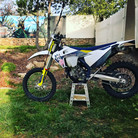

I picked up this delightful oddball earlier this summer. As someone who was raised to appreciate the offbeat and the oddball, the WR200 has been lurking in the back of my moto brain ever since being imported into the US in '92. I have vague childhood memories of seeing a smattering of coverage of them in motorcycle magazines, but they were always one of the oddball unicorns at the periphery of the moto universe.
This summer I found one that was *sorta* on my way to a project, and at a price that I deemed reasonable. Having recently rented a shop space, I was in dire need of decorations to clutter it up, and this was just the sort of object to reflect my carefully curated tastes. The WR 200 is a bike 30 years ahead of its time. Intended as a competitor to the KDX 200 (which practically invented the 200 class), it was a decade behind Kawasaki in terms of consumer experience / brand loyalty, and product development (here's looking at you, Jeff Fredette). The WR offered a slightly different riding experience than the KDX; but as the KDX had been operating virtually without competition in the 200 class, it had come to define what riders were expecting out of a 200 class machine. The result was similar to loving, devoted parents dropping off their brilliant, slightly chunky, socially awkward homeschool prodigy at a hyper-competitive boarding school, and never talking to them again. It was picked on, bullied, and eventually ran away to foreign countries where it was appreciated for it sophistication and resourcefulness.
Yamaha offered virtually none of the support and development that Kawasaki had been investing into the KDX 200 through Team Green and Fredette Racing. Taller and heavier than the benchmark the KDX had established, having power characteristics more in line with the mellow four-strokes of the time, it did not fit into the medal-winning expectations curried by Jeff Fredette and his multiple ISDE medals, and dominance of the 200 class here in the States.

I readily accept that my '83 XR200 is a 40 year old bike; air cooled Honda four strokes are an integral part of my childhood memories. Even into the mid-'90's, we were still meeting the nicest people while riding our twin shock, air-cooled dinosaurs with a clear demarcation line between gas tank and seat. Sitting down to do the math, it is inconceivable to me that a linkage-equipped, liquid-cooled two stroke (look at that glorious expansion chamber!) with full-cover radiator / tank shrouds and a seat extending all the way up the gas tank is now a 30 year old bike. It makes me realize that I still think of the '90's as just being a decade or so ago, and everything from 2000 on just seems like an extension of the present day.
When I picked up the WR, it had the distinction of starting and running, but nearly every fastener was loose or mismatched, the petcock dribbled as much gas onto the engine cases as it did into the carb, and the roached bearings combined with the ring-ding two stroke sound really enhanced the "jangling tambourine" effect of riding the bike on some test laps around camp. Body panels falling off, gas soaking my boot, the sweet smell of pre-mix in the air, running out of fuel and coasting / pushing back to base; the first rides on my project were a pure shot of childhood nostaliga memories from growing up on shitty old bikes, and figuring out how to keep them running.
The appeal of these project bikes to me is not to create an OEM-perfect, showroom floor stunner; but to keep them out on the trail, exploring the outdoors, getting into predicaments with friends, and problem solving your way back home. Starting with a neglected bike sets the bar of expectation much lower; practically anything you do is an improvement.
Great now I want a WR or IT 200
Cool little bike….
Nice "light" enduro, very rare to see here in Europe. A friend had one in the 90s, imported from Japan.
Enjoy the build! ✌️
Winter is my off-season, and chance to catch up on all the shop projects I have been deferring / accumulating. With valves checked to be in spec, and a new sparkplug (no small task) on my FE 350, the XR200 back to functional status, and the TW trail rig's issues at a manageable level, it is time for the WR to take center stage.
With the bodywork removed, and the bones of the bike bathing in the warm shop light, I had to contemplate how far I wanted to go with this project. The layers of accumulated gunk, exhaust spooge, chain lube, and various leaks made it feel a bit sacrilegious to just throw in a top end and shiny pipe, and call things good. Taking the motor out of the frame is the only way to adequate divest the accumulated decades of funk. Once you take the motor out of the frame, it feels awfully close to being a frame-up restoration. Strip it down to the frame, and painting the frame seems like the next obligation. Not to mention there is an easily overlooked Prateo effect hiding in all those miscellaneous bits & bobs attached to the frame. Not only the extra, always expanding time required to take off all the doo-dads & accessories, but the exponentially increased potential for loosing a critical, no longer available component along the way.
In interest of mitigating exposure to these risks, and preserving the existing "functional patina" of the frame, I am choosing to limit myself to pulling out the engine to power wash it, and the frame separately.
The Shop
Luxon 4-Post Bar Mounts
$189.95 - $239.95
Free shipping: VITALMX
DeCal Works Huge Plastic Inventory of UFO and Polisport kits.
They were a reasonably popular bike here in OZ.
It's a long time ago, but, my recollection is the motor originally came from some sort of Japanese home market Scooter / Commuter. The engine, , a later version of it, I think, was also used in the SDR200 - a trick little trellis framed 200. Now they were a Very cool little bike :
And , in Japan, they came with steel tanks. I think some came here with that fitment.
Either Pro Circuit or FMF (both?), made a Chamber and Muffler for them, that spiced up their performance somewhat - well, hugely, as the std Chamber was very restricted - I think Washers welded in, and mesh as a inner liner to the chamber. You may be able to find one.
I remember that Dirt Bike mag had a fairly perfunctory test of it, in what was a KDX200 dominated era. Yamaha in the USA, really didn't seem interested in it.
They could be made to go really well - they were a great little bike, as 200s always could be.
I snaffled a Devol WR200 Pipe guard that was gathering dust at a dealership I worked at, years after the WR200 ended, With a Lot of additional sections and welds, I was able to make it fit my CRE500s header section, to cover up to the OEM pipe belly guard. The WR200 pipe was like a small version of the 500s. It's still going strong on the old Teddy Bear of a bike, decades later.
Whattt????!!! I thought I had a pretty good handle on oddball motorcycles, but never had any idea about the SDR 200. Absolutely dreamy cafe racer / two stroke screamer right there!
Realizing that the WR / DT 200 platform had such a long run outside of the US is a large part of what made picking up this project seem like it wouldn't be so much of a wild goose chase for parts. From what I understand, this motor is an evolution of the IT 175 / Blaster series. The Blaster ATV engine added a counterbalancer, and this particular evolution added water cooling, and the electronic power valve.
I picked up an FMF pipe & silencer, and just removed the stock combo in preperation for cleaning the engine & frame. Holy smokes, the stock exhaust set up is heavy! I'm normally not much of a weight weenie, but I think I might have to weigh the two systems for comparison; I'm guess the FMF combo is half the weight of the stocker.
Cool little bike, and I am with you in thinking that anything post-1990 seems like modern-day. Am I correct in thinking that bike has a longer left-side radiator shroud than the right side?
Yeah, this one has the asymmetrical radiators. There's actually a small catch tank on the outside of the left hand radiator (visible in the pic above). I'm wondering if YZ 250 radiators from the same era would fit, and maybe give a bit more capacity.
Funny how I thought the asymmetrical radiators looked weird at the time, and now it's what makes it look so distinctly of its era.
^ I remember the asymmetrical radiators looking like works bike technology. Remember the '83-'84 Honda works bikes with the left-side exhaust and right-side radiators that went down to the bottom of the frame? The left radiator was the size of a deck of cards. Trick.
The biggest head-scratcher so far has been figuring out how to disconnect the powervalve actuator cables. Despite adjusting all the threaded barrel guides all the way in, there was no extra slack in the cables to facilitate removal. The normally bountiful fields of YouTube were barren in regards to this particular procedure, but this video provided some insight to the basic theory behind the single cylinder YPVS system : https://www.youtube.com/watch?v=IHR0C96Pvgg
By taking off the center nut, I was able to flip the pulley over, allowing the cables to come out of the system rather easily.
Hopefully it goes back together just as easy.
Yes... you jogged my memory on the YPVS removal. It's been about 12 years since I did it on my RZ350 when the jugs needed to be sent off to get bored. The twin cylinder system isn't much different -- there's just a rod connecting the left cylinder's valve to the right's and a cap on the other end.
Sometimes you get lucky, and your project bikes turns out to be not so much of a project. After getting the engine out of the frame, and lining up all the parts for a top end job, I pulled off the head to find an absolutely pristine top end.
Certainly not what I was expecting given the state of the rest of the bike, but I decided not to think about it too much. Buttoned the head back on, put the engine back in the frame, installed the new FMF pipe & second hand silencer, and matched up some fresh fasteners. Big shout out to Bolt Motorcycle Hardware for their hardware kits making what used to be one of the most frustrating aspects of putting a dirt bike back together an absolute breeze.
After a few rounds of chasing petcock & carb leaks; finally solved with a new petcock, and adjusting float height, the WR is back to functional trail ripper status. Raising the needle one clip addressed the mid range stumble, and with the FMF pipe & silencer combo, this bike absolutely rips. It is friendly enough at low rpms to putt around the junipers while exploring & bushwhacking, then transitions into absolute beast mode once it comes on the pipe. On the local hillclimbs, I find myself grabbing gears rather than downshifting, and it is always happy to keep the rear wheel spinning & powersliding through turns.
It's a bit of shame perceptions of the WR 200 seem to be largely based on bone-stock comparisons to the KDX 200, which had a much more ample background of development. My guess is that testers already knew in the back of their mind what the KDX could be like with mods, whereas the WR didn't have a decades-deep legacy of competitive success.
Does WR stand for "Winter Riding?" 🤣 ... Fast forward a few months, and the WR200 has become my new favorite. The low-budget, non-adjustable forks are the primary thing holding it back now. Cue up the used market search for more modern YZ front end, and my '25 FX 350 Heritage Edition will likely be spending some more time as shop decoration.
The info about this engine sharing parts with the Yamaha sdr 200 is wrong for the most part. Maybe some of the transmission and clutch parts might swap. It's actually older than the wr/dt200.
The wr200 is nothing more than the dt200wr the rest of the world got. Just stripped of most of its street lights. And a different more off road friendly carb and the oil injection removed.
The engine has more in common with the tzr125 / dt125 from the mid 90's. Then there's the dt230 aka lanza that was the like upgraded version of the 200. Where they added e start and it got a 25cc bump to 225cc's.
Other than center cases being slightly different because of the added e start. And the cylinder change because of the cc increase. It's the same engine as the wr200. Even the engine mounts are the same.
The Dt230 engine is used in the China bikes like gpx tse250r or kayo Under license from Yamaha.
The ongoing legacy of the WR/DT engine platform is a large part of what made this bike such an appealing project to me. It delivers unicorn status (at least here in the US) without the frustration of parts sourcing that goes along with true limited production unicorn bikes (side eye glance at my '83 Honda CR 60).
I was prepared to go down the rabbit hole of engine mods in sourcing DT230 / GPX parts for this build, but it honestly runs strong enough with just the FMF pipe & silencer to suit my tastes. Upgrading to KYB/SSS YZ front end for improved suspension, and more adjustablity (further forward) in handlebar position are the next priorities in improving the already impressive ride capabilities of this bike.
This is my unicorn 1994 yamaha tzm 150 it was sold in se Asia. 1994 first year sold till 2000. It has the engine from the tzr125 / dt125. But with a 150 top end.
I haven't done anything to it except put an aftermarket exhaust on it. I got it to do 95mph pretty much maxxed out. I still had 1000rpm before indicated red line on the tach. But it was starting to vibrate a bit too much for my liking so I backed it down. Only time I've ever really tired a top speed run on it like that.
It gets up to 60 mph pretty quick and can cruise around there all day. I'm the only owner of this bike. I bought it back in end of 2018. Was sitting unsold all that time. It was considered expensive high end in it's home market. We look at it and say it's entry level.
The Bearded Mechanic on Youtube did a nice vid on the same bike, WR 200.
For those who are interested, here is a link to the video. Quite a bit of good info about the bike, and the teardown process is informative if you are doing one for the first time. I got a good laugh out of the airbox removal, as it is a genuine PITA; I found I had to remove the shock as well to get the airbox out.
There are some folks who will tell you that 200's are under-powered for hill climbing. I don't know who those people, but they certainly aren't me. Enjoying the secret season of the desert with a fellow 200 enthusiast, and not once complaining about a lack of power.
Pit Row
What do you all think can be done about the seat cover, if anything? I have a seat cover that has that sort of staining but not as severe. Is riding the bike helping at all? It helped mine some but it's been 60+ hours now and the cover could still use more work.
I'll probably just go for a new seat cover. There are some signs of fraying at some of the edges & seams, so there doesn't seem much point in trying to get this one all sparkly. Cosmetics are pretty much last on my list for this bike. Hoping to have it all dialed in as my "modern" race bike for the Florence GP this year.
Post a reply to: '92 WR200 Oddball Unicorn