



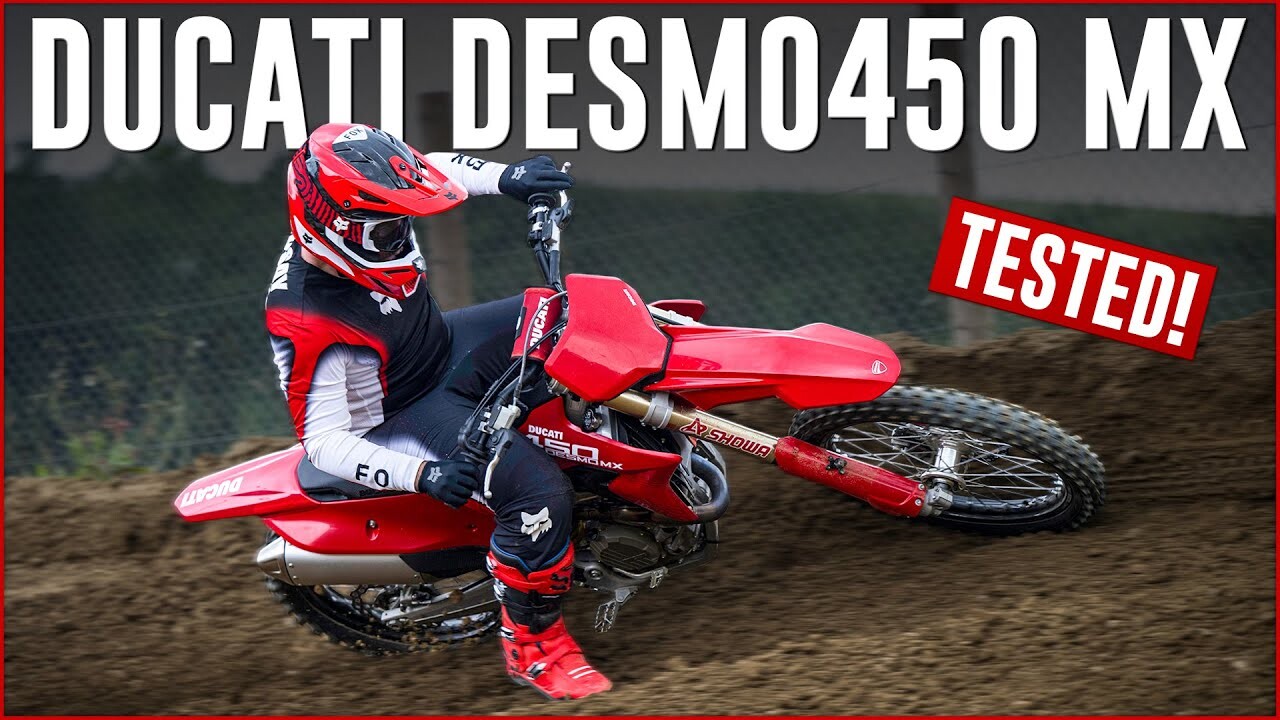
Ducati has officially thrown its hat into the highly competitive motocross ring with the release of the all-new Desmo450 MX. After spending a day riding the bike at Park 04, a freshly purchased and reworked track owned by ex-MotoGP star Andrea Dovizioso, I walked away with a few opinions of Ducati’s first serious off-road effort—and intrigued by the unique character it brings to the class.
First Impressions
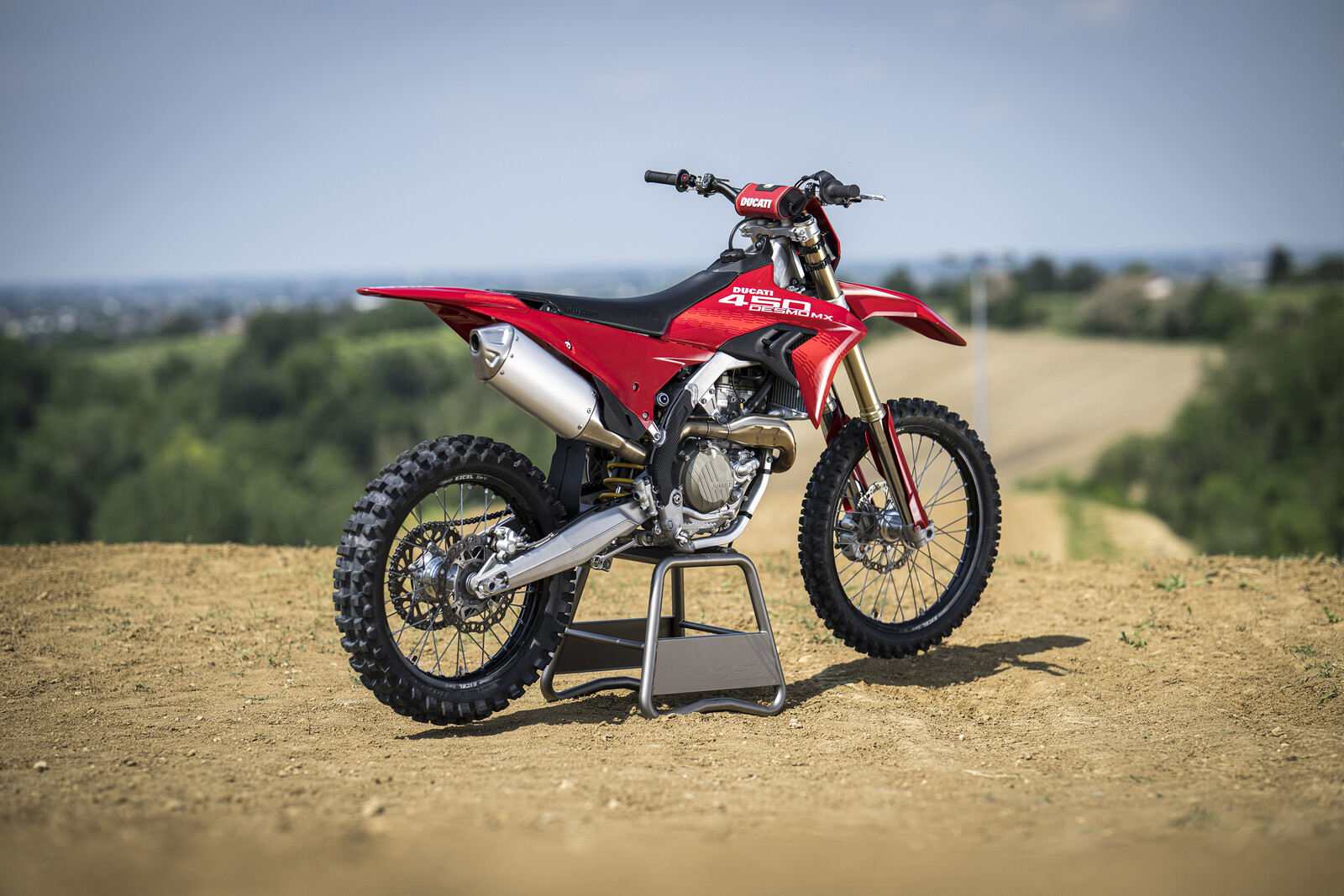
From the moment I threw a leg over the Desmo450, the ergonomics felt spot-on, with a rider triangle reminiscent of the Honda CRF450R. Something most of us would consider a gold standard when it comes to rider comfort. For those maybe wanting a bit more detail, what does that mean? Simply put, the distance between the bars and seat, then the seat and footpegs are just...well...very even. This creates a rider cockpit that seems to work well whether you're short or tall, maybe with a couple of simple tweaks (bar mount height, small seat height changes, etc are easy). Speaking of the seat, it's not quite as flat-profiled as some current bikes. It seems to meet a middle point of that old school pocket towards the front, while still being a little flat, mostly towards the rear.
Watch the bike in action and hear our thoughts by clicking on this video:
Basically, it's a great starting point. On top of that, Ducati nailed the fit and finish. The plastics, side panels, and shrouds are tight, functional, and free from any snag points. Aesthetically, it’s a stunning motorcycle...clean, compact, and I'd say unmistakably Italian.
Specifications
Engine Size: 449.6 cc
Bore and Stroke: 96mm x 62.1mm
Compression Ratio: 13.5:1
Power: 63.5 hp (46.7 kW) @ 9,400 rpm
Torque: 39.5 lb-ft (53.5 Nm ) @ 7,500 rpm
Gearbox: 5 Speed with Quickshift on upshifts (selectable)
Primary Drive: Ratio 2.45:1
Gear Ratio: 1=31/15, 2=30/18, 3=28/20, 4=26/22, 5=24/24
Final Drive: 13T front and 49T rear
Front Suspension: Showa 49mm, fully adjustable - 310mm / 12.2in
Rear Suspension: Showa mono shock, fully adjustable - 301mm / 11.6in
Front Tire: Pirelli MX32 Mid-Soft 80/100-21
Rear Tire: Pirelli MX32 Mid-Soft 110/90-19
Wet Weight, No Fuel: 231 lb (104.8 kg)
Seat Height: 38.2 in (970mm)
Wheelbase: 58.8in / (1,494mm)
Rake: 27.3 degrees
Trail: 4.65 in / (118.4mm)
Fuel Tank Size: 1.9 US Gal / (7.2 Liter)
Warranty: Ducati 3 months or 20 hours of use
Oil and oil filter service 15 hours
Piston replacement 45 hours
Valve clearance check 45 hours
Main engine service 90 hours
Engine: Desmodromic Meets Moto
The standout feature of the Desmo450 is the Desmodromic valve system, which Ducati has pulled directly from its MotoGP and Superbike heritage. Rather than relying on valve springs and more to close the valves, Ducati's system uses a second follower-style arm to control valve closure, allowing lower friction and better high-RPM stability. While that may sound like high-end race tech, the results are real and noticeable.
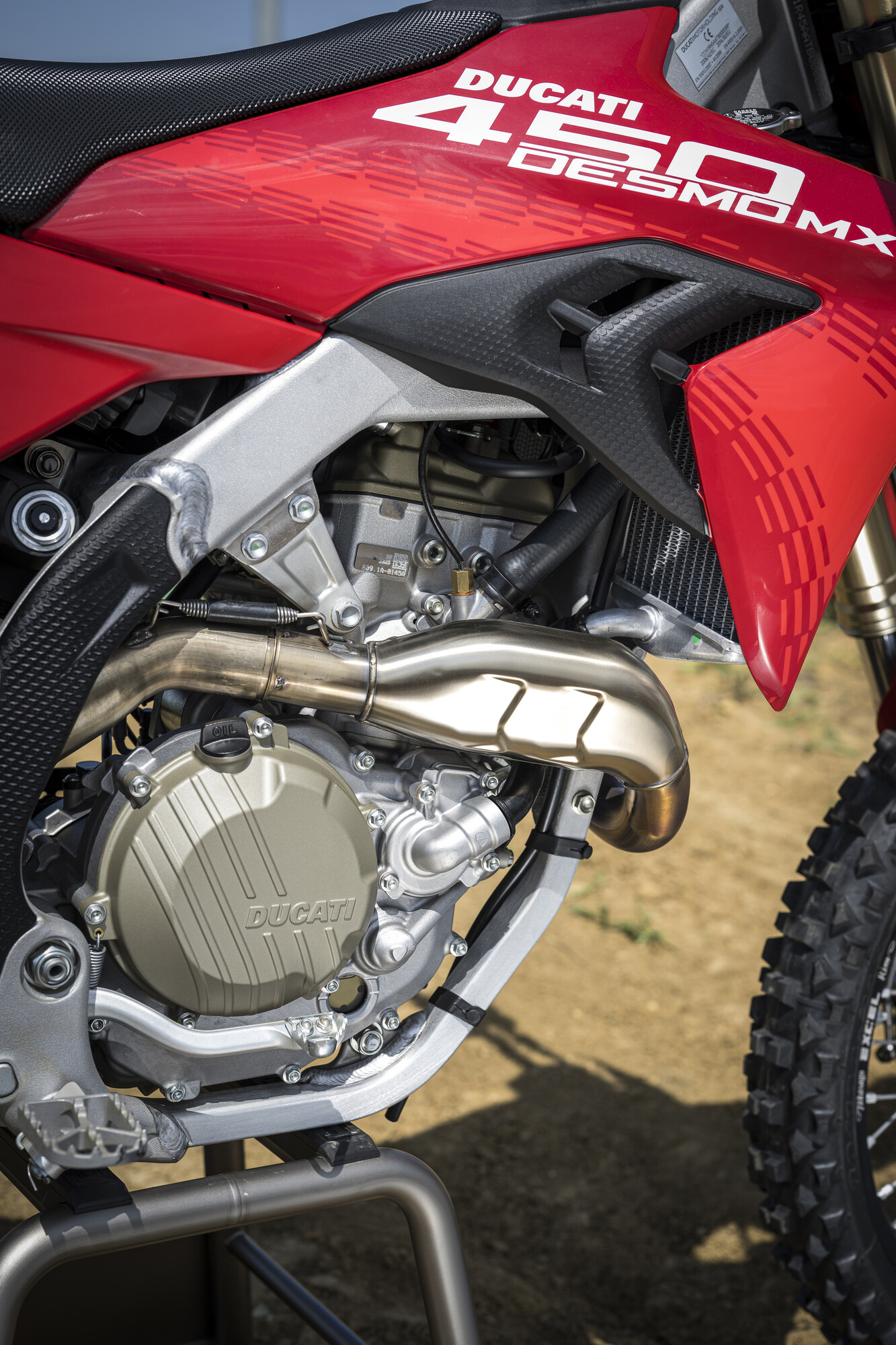
Initial impressions? The engine has a free-revving, 350-like character. It’s not a torque monster off the bottom, but once in the mid to upper RPM range, the Desmo450 pulls exceptionally well...better than any 450 I’ve ridden in that range. It revs around 800 RPM or so beyond most competitors, which may not seem like a lot. However, most 450s really feel like they quit making power after 9,000-10,000 RPM or so. While yes, the Ducati doesn't make its peak horsepower and max RPM, it carries closer to it than any 450 I've ridden. Meaning it feels like it keeps pulling right up to the limiter. On top of that, there’s less inertia or resistance at this higher RPM than its competitors. This made the Desmo450 the bike feel agile and a bit "light” at speed.
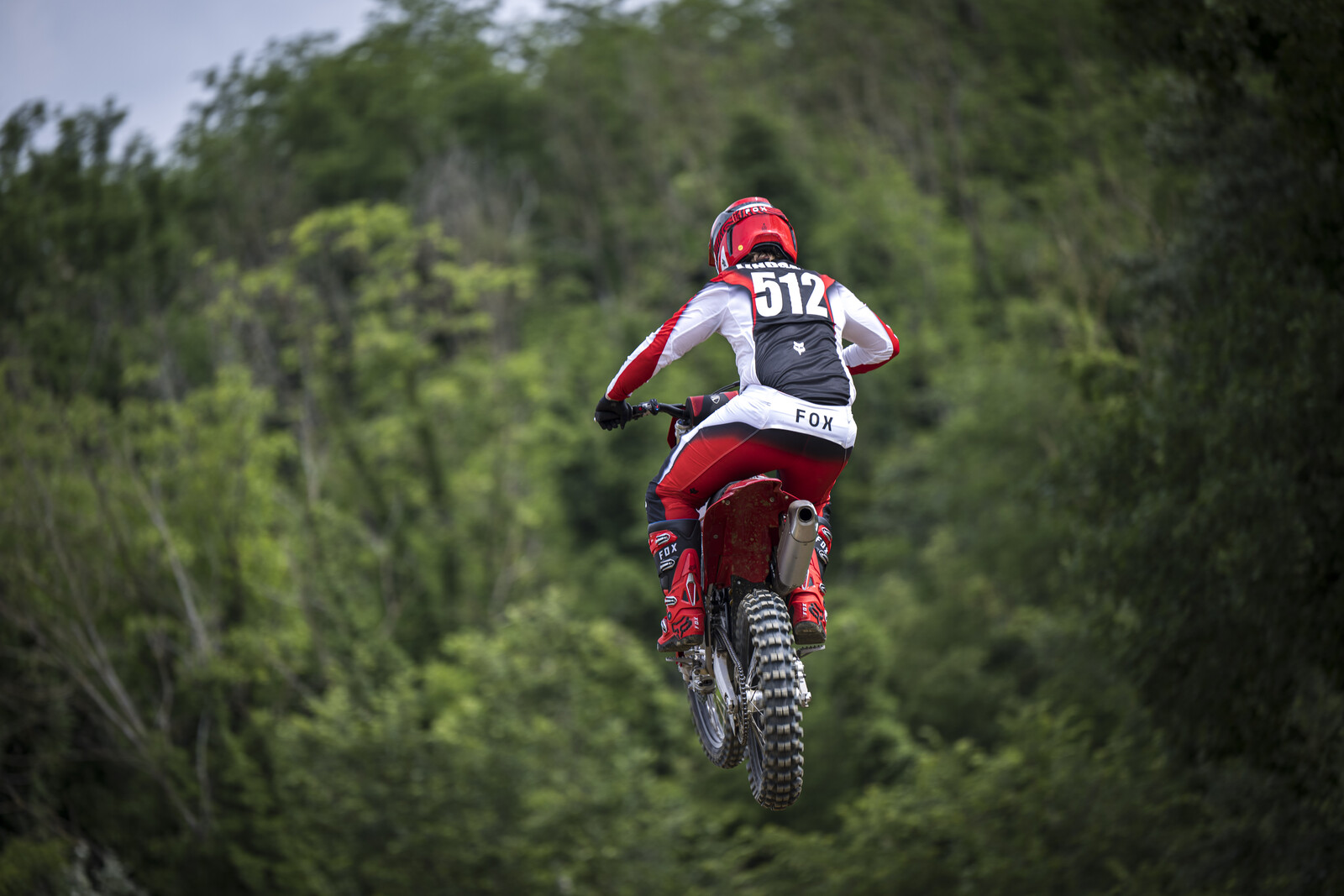
That said, low-end torque and throttle response at low RPM are soft, and the mapping feels slightly disconnected in tight, technical corners. Ducati’s engineers confirmed some rich fueling off the bottom, which led to inconsistent throttle feel. Their goal was to get a bike that didn't feel like it hit too much or had too much snap off the bottom, but in doing so, I personally felt like it was too rich and too soft at the bottom. Combined with the gearing choice (which I will get to in a second), the bike felt lethargic at low RPMs, almost a bit stuttery in corners. One thing to note here, the bike I rode was technically a pre-production motorcycle. I know Kris Keefer and I were both a bit adamant that this area could be better. So maybe some tweaks could happen with the mapping before the production models ship? I'm patiently awaiting our production test bike in a bit less than two months.
Okay, so about the gearing. Yes, it is very tall. Second gear is long enough to handle entire uphill sections, I only used third in a few spots, and I never touched fourth all day. That’s both a blessing and a curse: less shifting means more focus on lines, but the gap between second and third is wide, and the soft low-end doesn’t help if you're forced to short-shift. Basically, I had to reprogram my brain a little and try to ride it a little more like a 250. Not too aggressively, just remembering to use up a gear before pulling a shift.
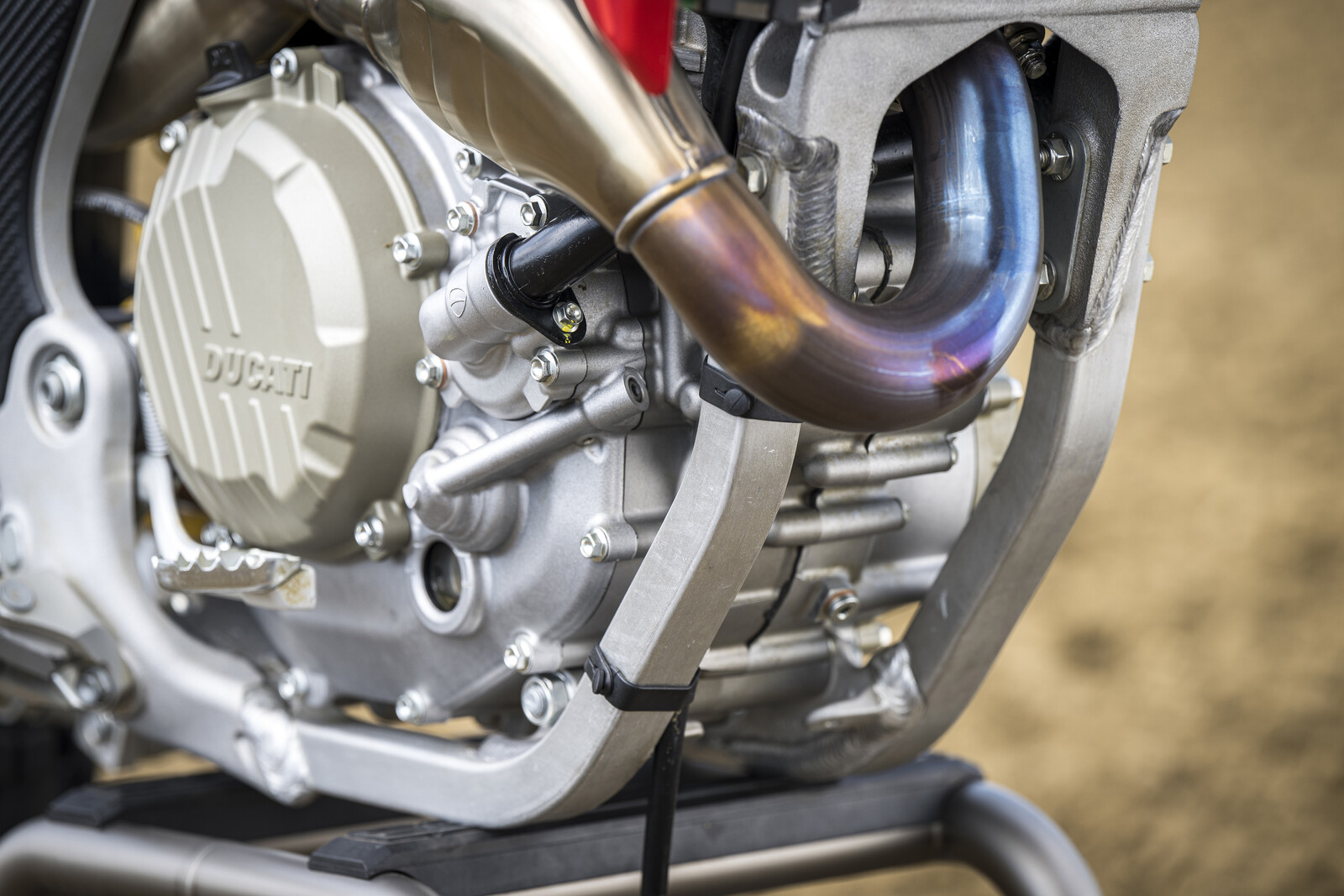
For tight tracks, I’d recommend adding a tooth or two to the rear sprocket to close that gap and bring the bike into its sweet spot faster. I think the testing staff mentioned Lupino raced with as high as a 52 or 53 tooth rear sprocket last year, with the production bike having a 49.
Electronics: A Few Choices to Make
Ducati’s electronics suite is perhaps the most sophisticated in motocross. It includes:
- True traction control based on rear-wheel speed and bike momentum—not just RPM spikes.
- Adjustable engine braking
- Launch control
- Quick shifter
The traction control in particular is more refined than anything else on the market. It adapts dynamically to riding conditions and can even be temporarily disabled via a clutch-lever sensor. I preferred the lower settings, which offered subtle intervention without the choked-out feel of other OEM systems.
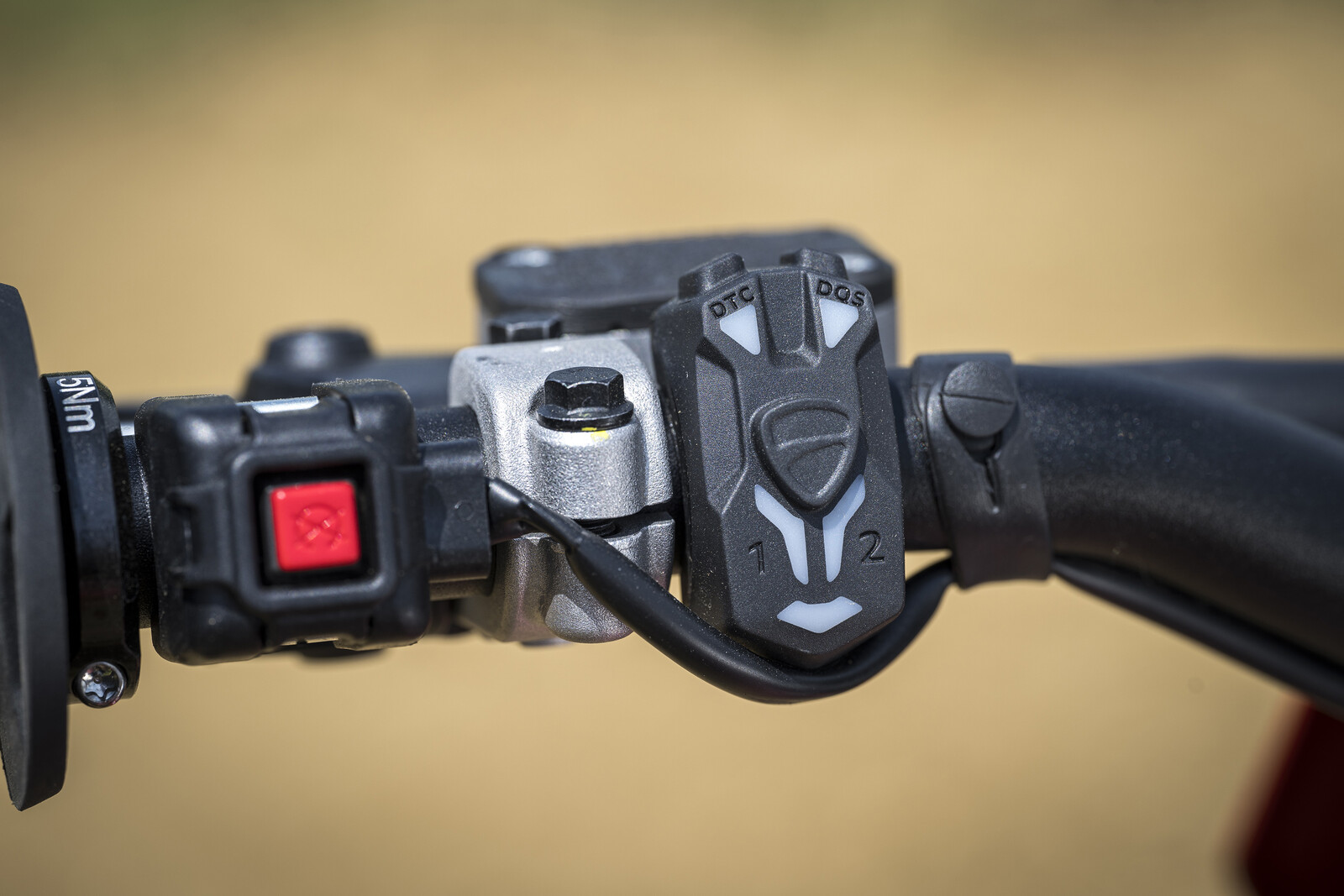
How is it dynamic? It knows rear wheel speed based off a sensor on the main shaft leaving the engine. Combine that with the bike knowing what gear it is in, it roughly knows rear wheel speed. The bike also roughly knows how fast its moving, if it's jumping, or hitting whoops based off dynamic sensors. Basically, the Ducati engineers told us they wanted to get the bike to a point where it kinda knows if it's exiting a corner, the most important place for traction control to work.
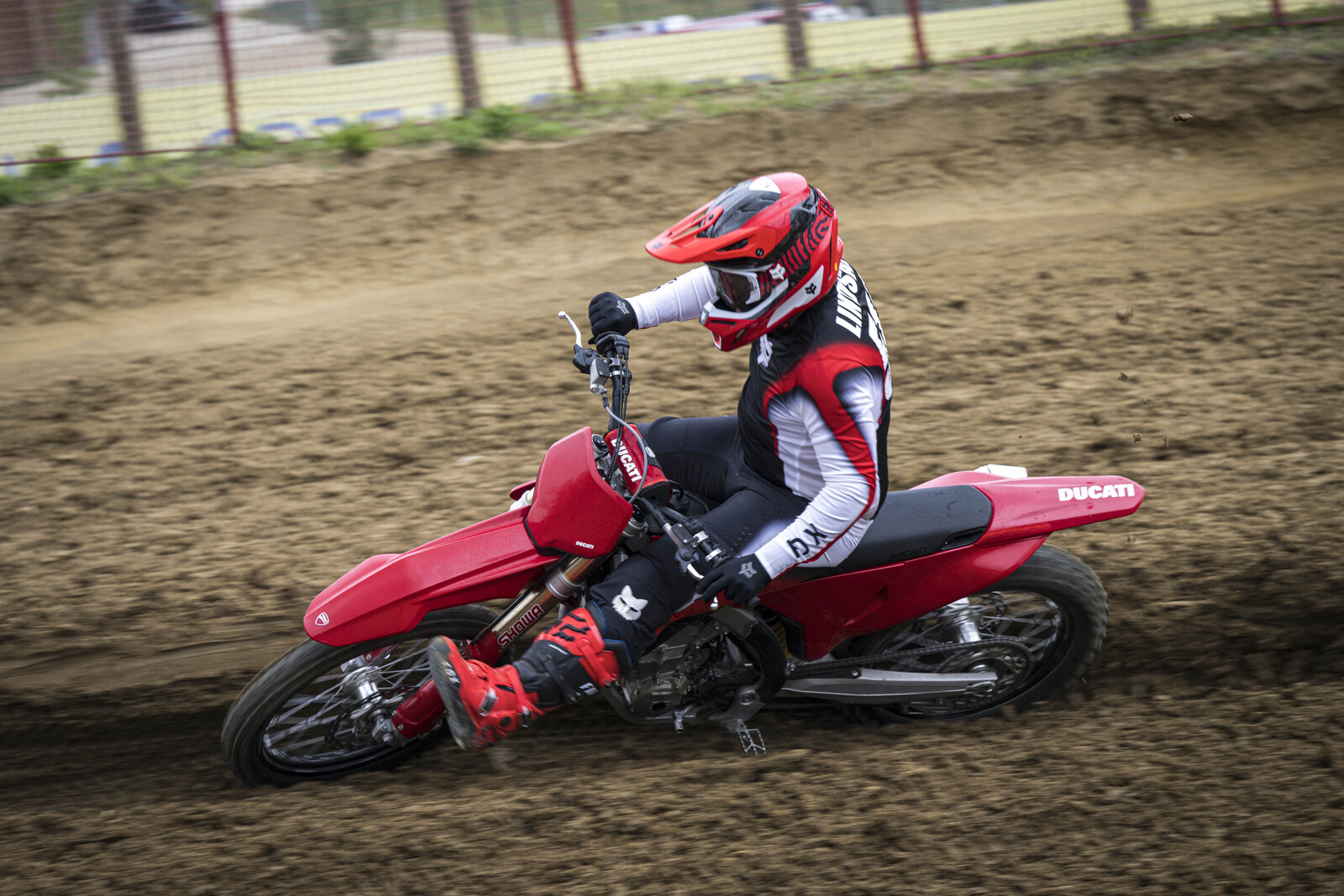
The quick shifter works well under certain conditions but is sensitive to boot input—especially with wider boots like the Fox Instinct. I ended up disabling it for most of the day.
Chassis, Suspension, and Handling
Ducati claims this suspension package is close to what Alessandro Lupino raced part of the Italian Championship on, so I was a little bit shocked to find it on the soft side...particularly the front fork. To combat this, I lowered the fork a few millimeters, went stiffer on compression and faster on rebound. However, we were also on a very hardpacked Italian track and going much stiffer would cause a loss of traction that my...spoiled by well prepped tracks-ness, would struggle with. While I did some similar tweaks to the shock, I found the fork to be the softer of the two and my immediate want to adjust.
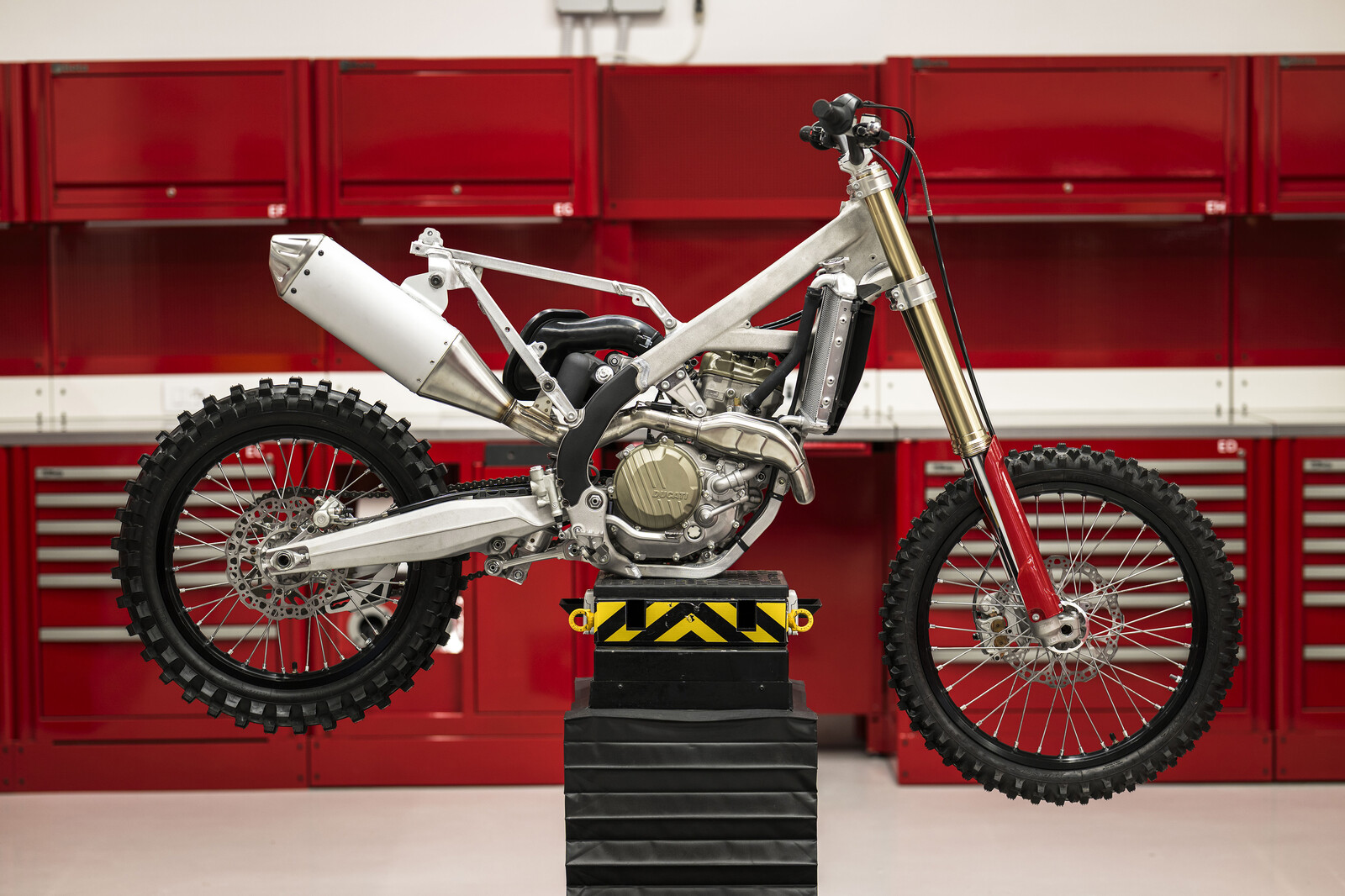
How's the chassis feel and handling? For my quick impressions, it felt fairly balanced and stable. Again, to use a comparison, it kinda reminds me of the current CRF450R chassis. Overall, it feels like it slightly leans towards being a front-end driven motorcycle. Giving the rider a lot of feedback to the hands and rewarding a front-led riding style. With that, is the front end comfortable? Hard to tell with the limited seat time, hard packed track, and few bumps. My initial gut feeling is it might not have as much comfort as say the Kawasaki KX450, but we will learn more when we get time on it.
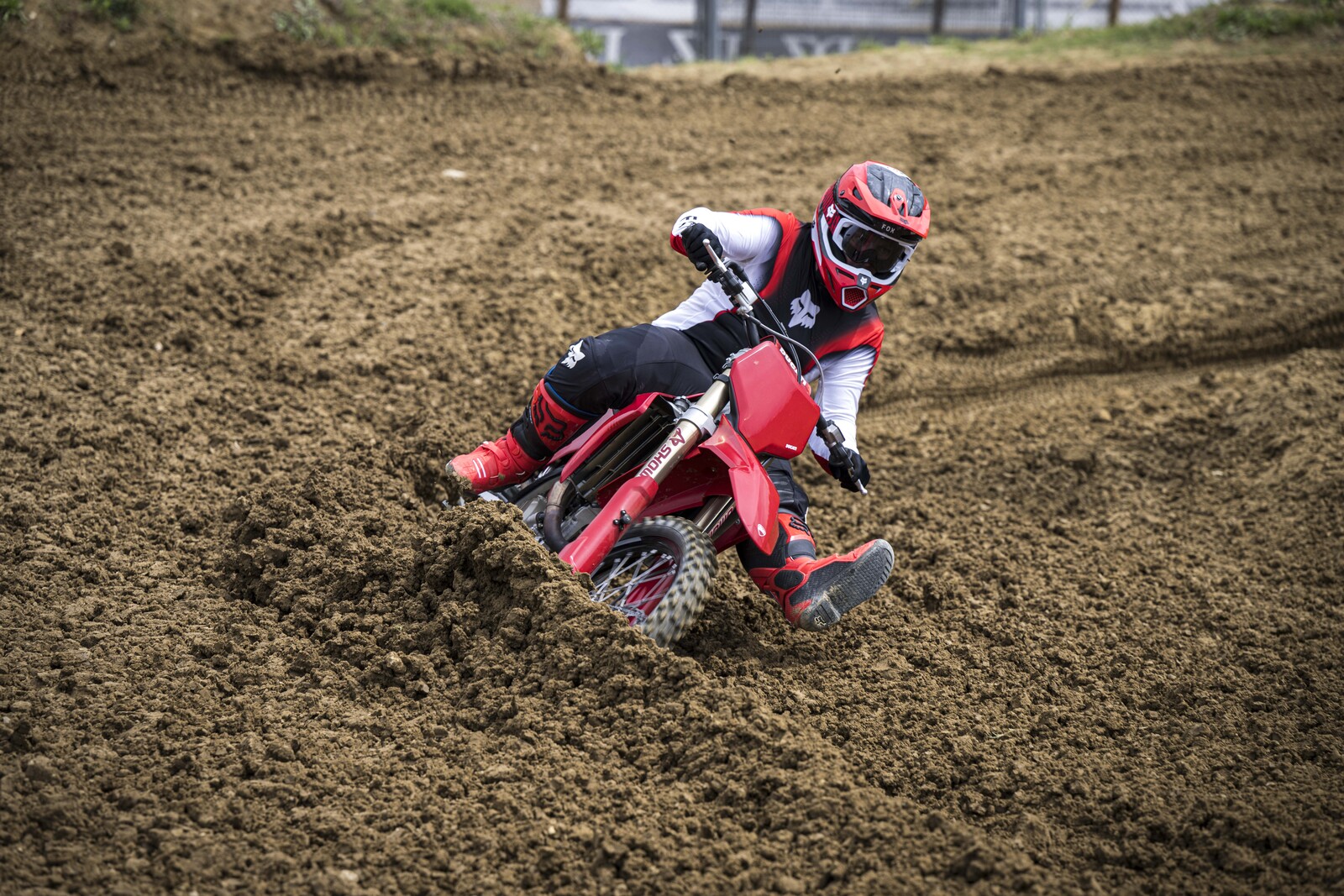
Handling wise, there was something interesting. Compared to most in the class, I felt like the bike had a bit of a high center of gravity. Maybe because of the taller Desmo engine and valve train. As a result, the bike needs a bit more input to tip into corners, especially at lower speeds. While playful and flickable at speed, it feels heavier than others in tight sections. This is also a bit due to that soft/disconnected feel down-low in the RPMs. Typically, a bike with soft low-end can feel heavier at low speeds since the power doesn't pick up the bike as easily out of corners. Overall, it's one of the lighter bikes in its class, and feels as such in some places on the track, but not as light in other places. A bit of give-take...
Small Notes
The bike ships with Pirelli MX32s and a 110/90-19 rear tire, a brand and size choice only mirrored on the 450 from Triumph. Given the bike’s softer low-end, the 110 makes sense, aiding spool-up and lean-in agility. Honestly, in stock trim, a 120 might exaggerate the bit of heavier lean in character I noticed and take away a little from that quick response in the mid-range. I will explore tighter gearing before giving the 120 a shot when we get this bike in later July.
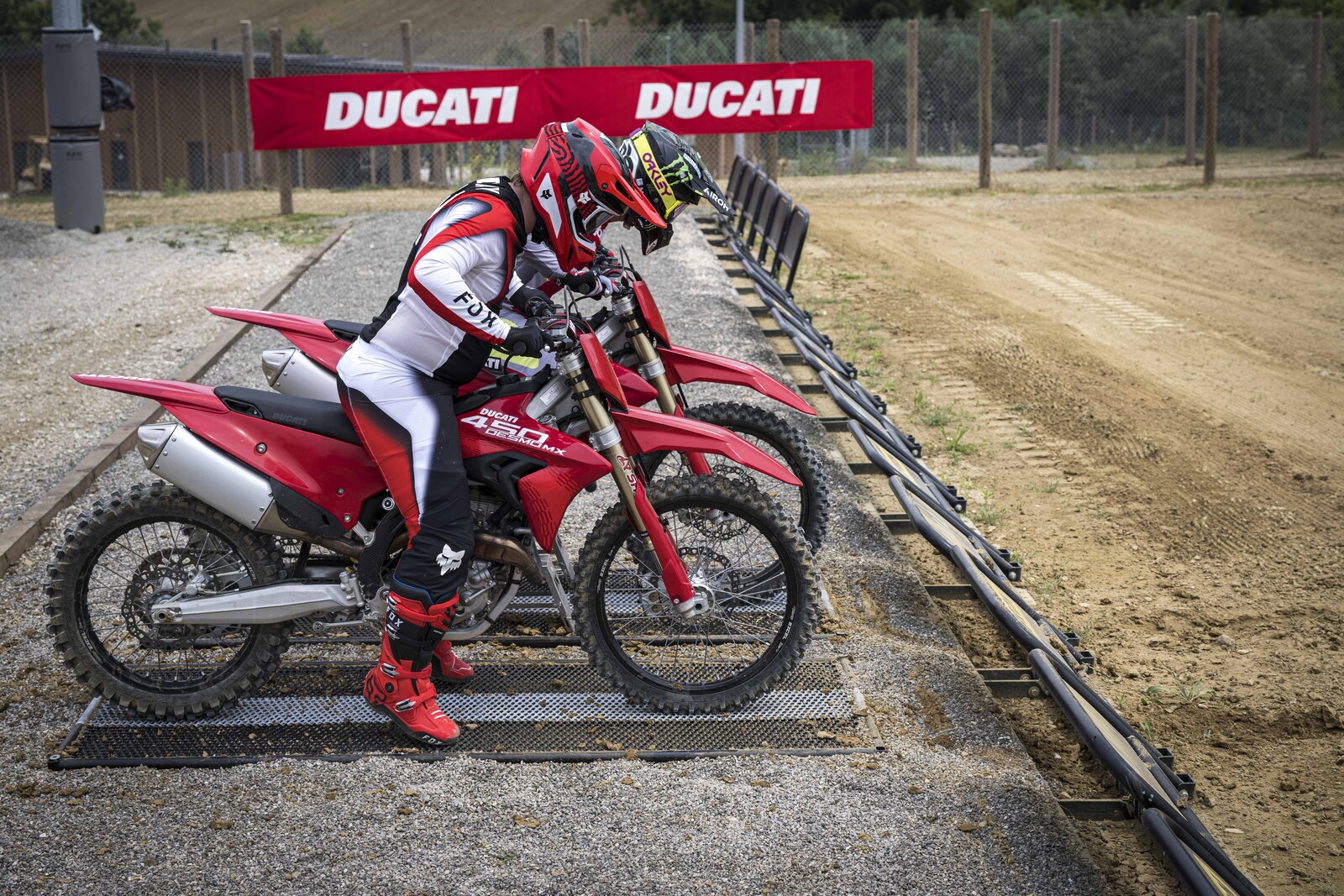
One surprise? The throttle pull is heavy. It’s not a deal-breaker, but for a bike that rewards aggressive, high-RPM riding, it wasn't the perfect match.
The seat is slick, a gripper or ribbed seat cover would make a big difference. Also, the stock grips are thin, which are great for my small hands but caused some cramps or complaints from most test riders in our wave.
Final Thoughts: Is It Ready?
Yes, Ducati’s Desmo450 MX is a solid machine and one I personally want to own in its first iteration. The fact the bike brings some different character to the class, (while not being too far out there) is exciting and well appreciated by this editor. It doesn’t have brute low-end torque, and the mapping needs refinement, but as a first-year effort, it's remarkably polished.
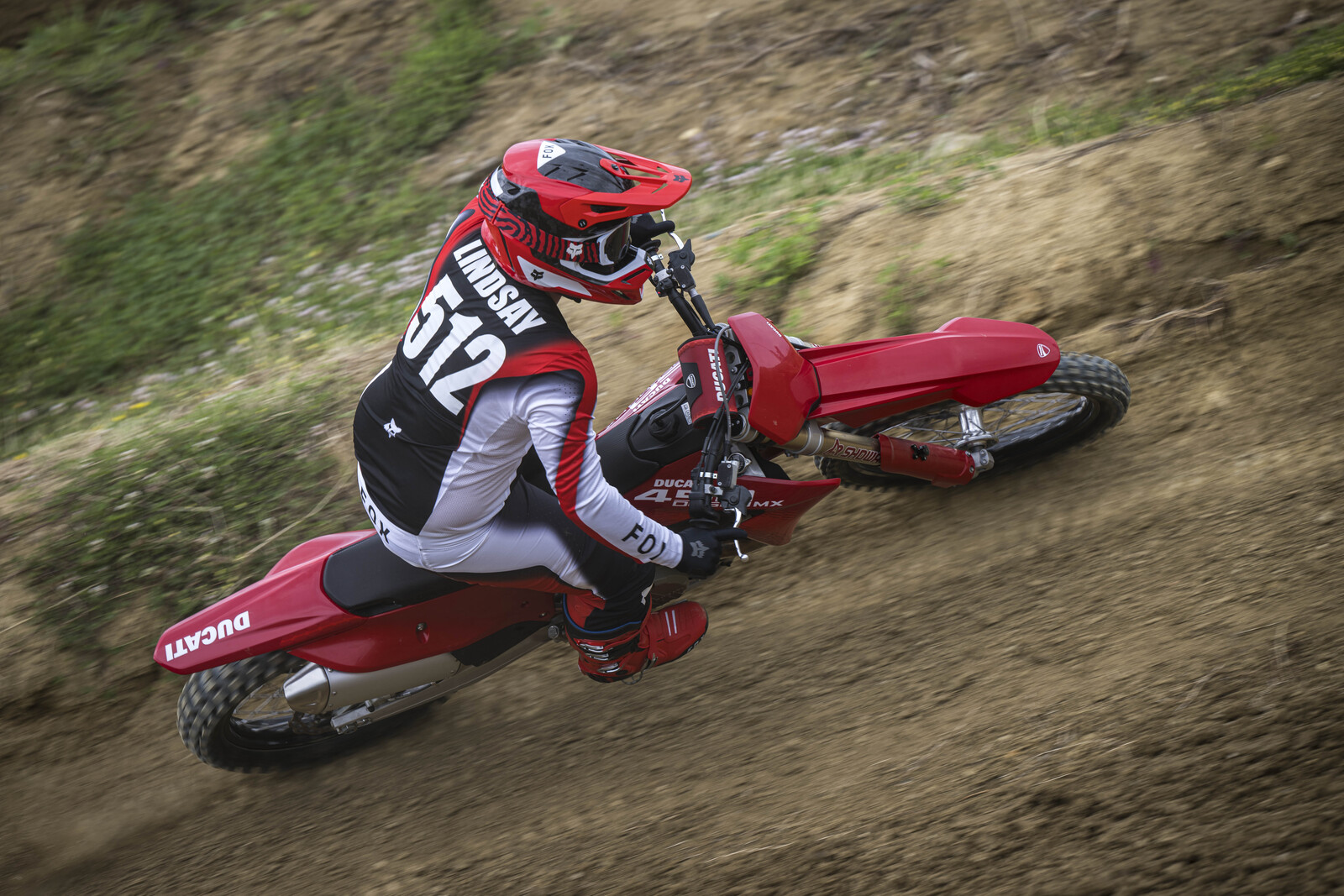
Is it for everyone? No. Riders who live in the bottom-end torque zone may find it too soft. But for high-RPM riders, 350 lovers, and those who like to ride aggressively and use momentum, it’s a dream. For those in between? Stay tuned for more or take a shot on it yourself when it hits dealers shortly.
Pros:
- Desmodromic engine revs freely, rewards aggressive riding
- Excellent high-RPM power delivery
- Outstanding electronics package
- High build quality and clean aesthetics
- Ergonomics are spot-on
Cons:
- Weak low-end torque and disconnected throttle feel off idle
- Soft suspension tuning for a bike with MXGP lineage
- Tall gearing; big gap between 2nd and 3rd
- Throttle pull is heavier than class norms
- Slick seat, thin grips
Questions?: Throw them in the comment section below!
6/3/2025 6:20am
View replies to: First Ride on the All-New Ducati Desmo450 MX – Is it Ready for the Public?
Comments