




How white and affluent drivers are polluting the air breathed by L.A.’s people of color
This story originally published in Boiling Point, a weekly newsletter about climate change and the environment. Sign up here to get it in your inbox.
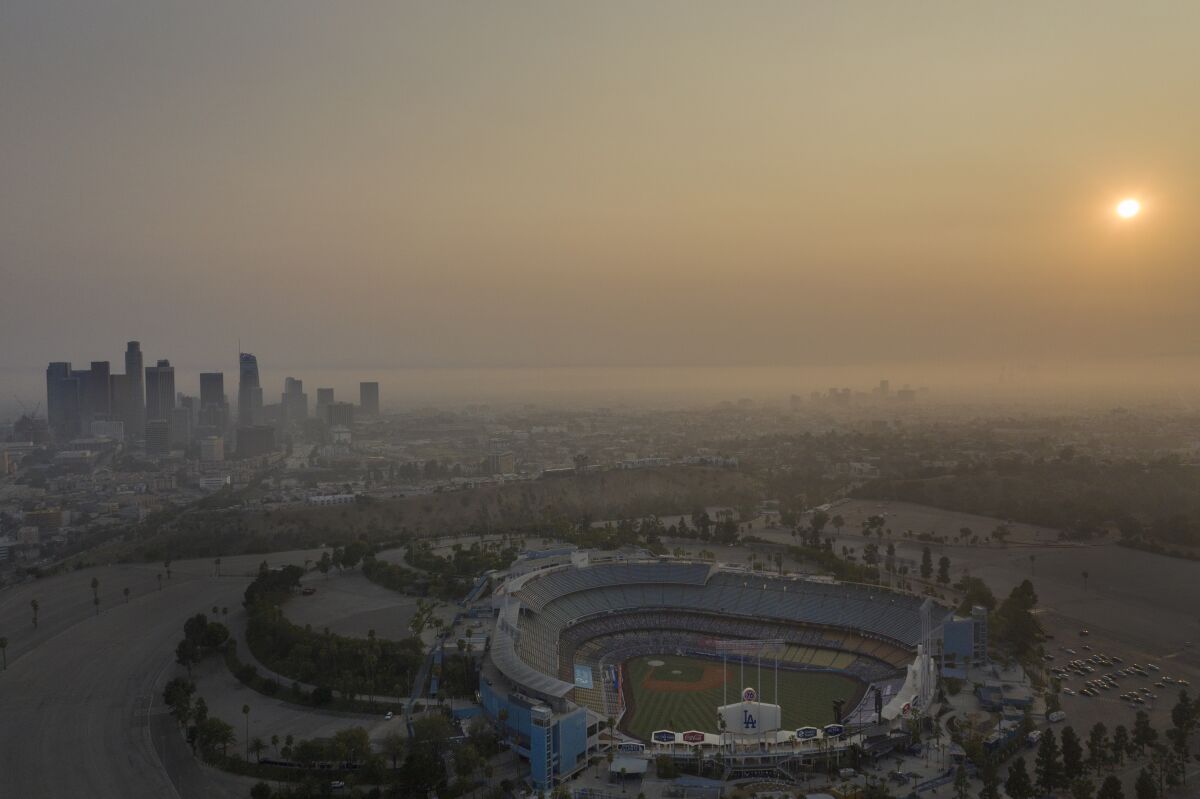
Like many Angelenos, I spend a lot of time behind the wheel of my car. I drive from my Westside apartment to Dodger Stadium near downtown and farther east to hike in the San Gabriel Mountains. I take the 405 Freeway north to the San Fernando Valley to see friends, or occasionally south to the L.A. Times office — or to the airport, where I grow my carbon footprint even further.
So I couldn’t help but consider my own complicity while reading a new study from USC researchers, finding that Angelenos who drive more tend to be exposed to less air pollution — and Angelenos who drive less tend to be exposed to more pollution.
It may sound like a paradox, but it’s not. It’s a function of the racism that shaped this city and its suburbs, and continues to influence our daily lives — and a stark reminder of the need for climate solutions that benefit everyone.
My colleague Terry Castleman wrote about the study, which was published in the peer-reviewed journal Urban Studies. The core finding is that for every 1% increase in miles driven to and from work by people who live in a particular part of L.A. County, there’s an estimated 0.62% decrease in the lung-damaging “fine particulate matter” to which those Angelenos are exposed.
How is that possible? I asked the study’s lead author, Geoff Boeing, a professor at the USC Sol Price School of Public Policy.
He told me it largely comes down to the shameful history of Los Angeles County’s low-income communities of color being torn apart to make way for freeways — a history that has been extensively documented by The Times. Today, many residents of the county’s whiter, more affluent neighborhoods — who were often able to keep highways out of their own backyards — commute to work through lower-income Black and Latino neighborhoods bisected by the 10, 110 and 105 freeways and more.
“It’s not like commuters are coming in and shopping in those communities, patronizing restaurants,” Boeing said. “They’re just driving through to get from one side of the city to the other.”
Southern California has some of the nation’s worst air quality. Cars and trucks are one of the main reasons why — and the closer you are to the source, the more danger you face. Whenever I move, I insist on finding an apartment at least 1,000 feet away from the nearest freeway, after reading an L.A. Times investigation revealing that people who live near freeways suffer higher rates of asthma, heart attacks, strokes, lung cancer, pre-term births and potentially other illnesses, such as dementia.
Boeing has gone a step further, taking an air-quality monitor with him when he and his wife were looking for a new home a few years ago. He got one of his highest readings for particulate matter near the 101 Freeway in Echo Park.
“I have a small child. I try as hard as I can to avoid air pollution,” he said.
Boeing’s family moved to South Pasadena — the “ultimate suburban flight story,” as he put it, and a place with a “terrible racial history.” Residents of the relatively affluent, predominantly white city were able to block construction of the 710 Freeway through their neighborhoods. As a result, he told me, truck traffic from the ports of L.A. and Long Beach ends up routing through lower-income neighborhoods in Alhambra, a city whose population is overwhelmingly Asian and Latino.
Boeing is acutely aware that he and his wife and son are the beneficiaries.
“I absolutely love that there are no freeways anywhere near us,” he said.
As a white guy who’s lived on L.A.’s Westside for most of my life, I’ve benefited from the region’s sordid history as well. Much as I try to do my part — taking the train a couple times a month, walking to local coffee shops and restaurants instead of driving across the city — there’s no question I contribute to the inequitable air pollution that Boeing’s study describes.
I was especially struck by this map from the study. The red areas are places in L.A. County where commuters tend to be whiter than people who live there; the blue areas are places where commuters tend to be less white than people who live there:
Indeed, my drive to Dodger Stadium on the 10 Freeway mostly takes me through red areas. At the same time, it’s interesting to note that long stretches surrounding the 405 and 101 freeways are blue — largely a function of geography, Boeing said, with urban planners having no choice but to route those highways through narrow passes in the Santa Monica Mountains.
Overall, though, the map shows how residents of whiter, wealthier communities disproportionately drive to work through lower-income Latino and Black neighborhoods, spewing pollution. Residents of those neighborhoods can’t do much about it.
“If you want to be exposed to less pollution, you can’t be the change you want to see in the world,” Boeing said. “It’s up to everybody else who is taking advantage of public infrastructure and releasing tailpipe emissions.”
Boeing was careful to note that the study doesn’t conclusively prove that patterns in how Angelenos get to work are solely responsible for different levels of air pollution in different communities. Majority-white Westside neighborhoods, for instance, could also be benefiting from ocean breezes that push pollution into predominantly Black and Latino areas, he said.
But the researchers’ close examination of driving patterns, commute distances and pollution — which involved a combination of data analysis and modeling — painted a clear picture of environmental injustice, Boeing said. In addition to the link between air quality and miles driven, his team found that non-white communities face higher pollution levels across the board.
So what do solutions look like? Getting more people into electric cars is definitely one of them. Another USC study published last month found that as more people drive zero-emission cars in California, fewer people are being sent to emergency rooms due to asthma — at least in the areas where people are buying and leasing those cleaner vehicles.
Gov. Gavin Newsom has set a goal of ending the sale of most gasoline vehicles by 2035. The climate bill signed by President Biden, though, could complicate that effort. As The Times’ Russ Mitchell explains, the Inflation Reduction Act is set to phase out federal tax credits for electric cars that aren’t built in the U.S. — at least a temporary obstacle for some automakers.
Regardless, switching from oil to electricity won’t solve everything, as Boeing’s study notes. Electric vehicles still produce harmful air pollution via dust from brake padsand toxic chemicals in tires. And cars of all kinds can kill pedestrians and drivers.
Policymakers could help limit the need for long commutes, Boeing and his co-authors wrote, by offering tax credits to incentivize working from home and charging “congestion taxes” to make driving more expensive — an idea being studied by L.A. County.
The researchers also called for government to allow more apartment construction in wealthier neighborhoods, to make it easier for low-income families to live closer to where they work — instead of in far-off enclaves burdened by freeway pollution.
Building more public transit could make a difference, too. But Boeing suggested that Southern California officials focus on buses more than trains, because the region’s sprawling suburbs often don’t lend themselves well to commuter rail.
“It’s hard to say that those hundreds of dollars in rail investment are really going to work when there aren’t that many people within walking distance of those stations,” he said. “Buses need to be a more central part of the solution in Los Angeles, because you can provision hundreds of buses with frequent service for far less money than one train.”
Unfortunately for public transportation fans, Newsom has proposed $2 billion in budget cuts for transit projects that critics say would make it even harder for local transit agencies — already struggling with lower ridership and decreased revenues coming out of the pandemic — to attract and retain riders. Newsom is due to release a revised budget proposal in May.
I realize it’s not on my shoulders alone to make up for a long history of racist housing policies and freeway construction. The same goes for you, if you’ve also benefited from that history. Finding ways to minimize and reverse ongoing inequities, while solving the climate crisis, is a project for all of society — government, industry and individuals alike.
But to the extent I can help, by driving less and taking transit more? And by spreading the word about studies like this one?
That’s an easy win.
Wow.... I didn't know people of color do not drive thru L.A. area ....ever.
" Everything " is racist in these people's eyes.
The word has lost it's meaning , and honestly doesn't mean anything any more. Snow is racist , owning a black dog is racist , driving a truck is racist , roads are racist , being in shape is racist , wiping my ass is racist , because the paper is white. In their eyes , I commit 1000 things a day that are racist.
Kind of proud of that really. And to be honest , I don't care.
The LA Times is racist. Change my mind!
I think you guys sit on the internet just looking for stuff to be offended by like it's on your bucket list
The Shop
Free shipping: VITALMX
DeCal Works Huge Plastic Inventory of UFO and Polisport kits.
Luxon 4-Post Bar Mounts
$189.95 - $239.95
You need to go outside. 🤣
Fuck you !
I haven’t seen a road in months
lol what a stupid ass article
Jeffro, get a bidet you racist piece of shit
That much digging must keep ya in shape
Now that’s the elicited response I expected! 🤣🤣🤣
It's a term of endearment up here
"The region's sordid history"
🤣😂🤣😂🤣
When you're buried in snow as long as Hermit has been, fuck you is very much a term of endearment.
I don’t care about this. What am I doing to them? Nothing.
The offset to this is that hardly any of those disadvantaged aren’t paying federal taxes.
It seems that disadvantaged are hurt by neighbors (pollution and crime), the city (taxes), and the state (sales taxes).
None of this means anything to me.
If the don’t like it they can move out of the city. But they choose to be there.
Math. You forgot math. That’s racist now too apparently.
I'm a selective racist. I hate certain people of every race. As of now I pretty much hate white people more than anyone, even being white myself. I literally just like to hangout with my dogs these days. People of any race are pretty much insufferable. Unless they're a hot chick. Hot chicks always get a pass...for 24 to 48 hours.
You know what they say:
"If you run into one asshole, you're unlucky. If everyone you run into is an asshole, maybe...."
That sounds like a “stand up comic” routine.
Pit Row
I’m an equal opportunity racist, hate everybody. 🤣
I think the media should post the definitions of racist and prejudiced as many times something labeled as racist is not.
know who will avoid this thread? Our liberal posters. As even they cannot defend this garbage. Signed, a racist that drives through urban areas to get to better areas.
I’m pretty sure racism has something to do with a deliberate act of race against race. Being oblivious is not racism. This article is just “reaching” on so many levels.
Oh, they’re here. They make there little anonymous “votes” and then retreat back to MSNBC
Please refer to the 5th post in this thread (from the smartest person in Non-Moto)
Easy there big boy.
This isn't a dating site, and I doubt you're his type.
I think a few of those may not be back here for awhile.
It's been awfully quiet lately.
🤣😂🤣
Are you sure?
My solution
I’m not sure what’s worse:
The fact that narratives like this are pushed in the media everyday to distract from current events, or the fact people think this is fake or satire.
Post a reply to: LA Times: Commuting thru L.A. is racist (not kidding/real article)