




In this installment of Industry Insights, we talk to John Casebeer, the owner and creator of the Slacker Digital Sag Scale. If you ride, you know how important it is to have your suspension set correctly. That starts with setting your sag, which typically is a two-man job and a bit of a pain. John Casebeer created the Slacker Digital Sag Scale to make it much easier and more accurate without the need for a second person. John discusses his background and the process of developing the tool.
For the full interview, check out the Vital MX podcast right here. If you want the condensed written version, scroll down a bit further.
Jamie Guida – Vital MX: Tell us about yourself. Was riding dirt bikes part of your childhood?
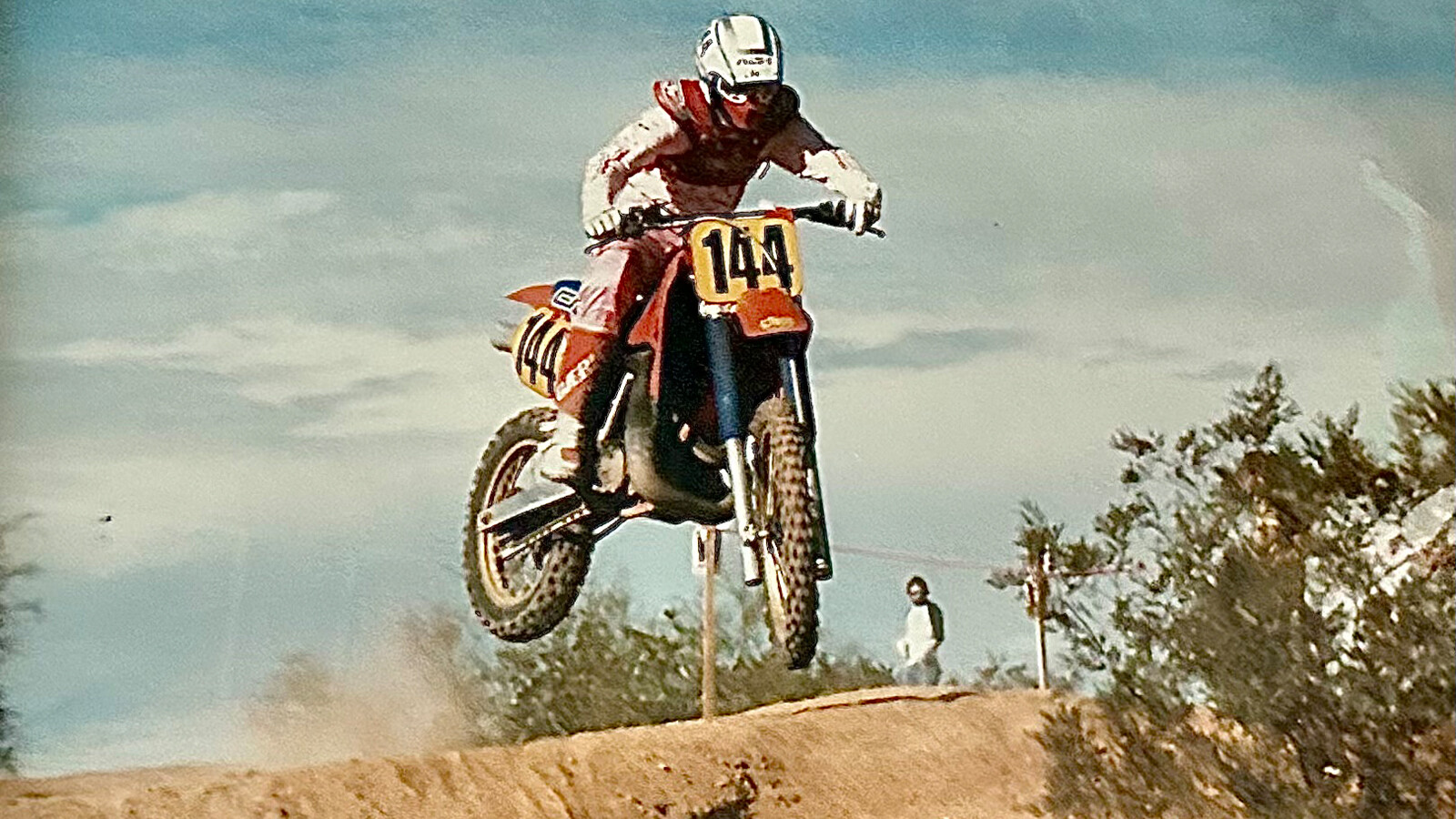
John Casebeer: I grew up in Flagstaff, Arizona. When I was a kid, my dad used to take us riding all the time. One day he decided to get a Honda XR185 and go off-road. We loved that thing, and he would always take us on rides. It got me wanting a dirt bike, so in 1979, I got my first official dirt bike. It was an XR75, and I rode the wheels off it for the next few years. Then, in 1981, I saw the Honda CR250 Elsinore, which looked amazing. It was the first water-cooled, single-shock Honda. So, I drove my dad and mom crazy for the next six months trying to get them to buy me one. For Christmas, I got one and it blew my mind. After that, we all got interested in the sport of motocross. My first race was in 1982 at Canyon Raceway in Phoenix. That track is still there. I rode there a few years ago. We raced Saddleback, Indian Dunes, and those classic stuff. We did the Gary Bailey Motocross School. I got to meet my hero, David Bailey, in 1985. After a week in Virginia training with Gary Bailey, I decided I did not want to be a pro. I was going to go to computer electronics school. It was way more of an actual sport than I had imagined. I just liked twisting the throttle. I just knew I didn't have what it takes to go pro.
Jamie Guida: Your path was leading you towards computer electronics?
John: Yeah, it was. I really enjoyed it and had a passion for it. It was before the internet, and I enjoyed learning how they worked and making new things. I went to the Hi-Tech Institute, got my associate degree, and quit riding. I couldn't afford it with going to school. I also started playing music and touring in bands over the next twenty years as a hobby. I didn't really ride for 26 years. I eventually got to the end of my music career due to being too old and tired of partying.

Jamie Guida: In 2012, you got back into riding? What brought that on?
John: I was so out of shape. I'm a network engineer, and sitting in a van and dragging gear up and down stairs was the only exercise I would get. I quit music in 2010 and spent a couple of years confused because it was a big life change. I did some soul-searching and decided to get back into shape. I tried mountain bikes, and that sucked. It was too much work. I couldn't enjoy the downhill stuff because getting up the hill was so hard. It dawned on me that dirt bikes are fun and it's a great exercise that would keep me interested. I bought a YZ450F, and things moved quickly. I hadn't ridden in 26 years, and I'd gone from two strokes to four strokes, which was bizarre. I really struggled with the turns but didn't know if it was me or the bike. I didn't know anything about bike set-up. We didn't set sag in the 80s. I had to study and learn all this stuff, and in the end, I learned the weight bias of that reverse engine was a little too far back. I got a DRD kit that allowed me to relocate the motor forward, which ultimately changed everything. In the meantime, I had gotten obsessed with sag. My buddy was a flake and never around, and most of the time, I second-guessed him if he took the measurement. So, I bought a little solo sag scale that would allow me to do it myself, but it was inaccurate. I went out and was struggling with this deep rut and ended up high-siding and breaking my ribs. That stuck in my head, and I was frustrated. I wanted that tool, but it didn't exist. I wanted to see the number on the handlebars, so I started ordering a bunch of open-source components to try to invent the first Slacker. I tried ultrasound, laser, and different things, and there were a million reasons it didn't work. After a couple of weeks, it popped into my head that I could hang something from the rear fender, and it would naturally go up and down at the rear axle. I got a little plastic box, mounted a magnetic linear encoder with some construction string, and hung an aluminum bar from the rear fender. It worked perfectly.
Jamie Guida: How was the process of sourcing and preparing the product for distribution?
John: It's an intense process. Once I got the prototype I knew worked, I started looking at manufacturing. Then my dad got really sick, and I went to Montana and spent his last couple of weeks on this planet with him. It felt like just two weeks before he had been taking us racing when I was a kid. Now, I was the age he was when he used to take us, and he was gone. It was motivating, and on the flight home, I decided that there was no way I would continue in I.T. and work for other people. I wanted to do something bigger with my life and make people's lives better. That was mid-December, and by February, I decided I was going to go for it. I sold my I.T. business and got enough money to get the manufacturing done. I found a nice guy named Paul who understood the product and worked with retractable cables. We synced up and got along. His company is called Creative Engineering, and they took it to the form you see now. It took about eight months, and, in the meantime, I filed a provisional patent. It was still a challenge once it was engineered for manufacturing because the engineers were in the United States, and the components sourcing was in Asia. We found a factory in China and got going. I got the first couple of batches, and as I made requests for changes, I realized they would never happen. I got frustrated and decided I would move it to a new factory. I found a place called One Step Sourcing, and if you are ever trying to source something and run across that name, run. The first run of orders was good, but things got weird. I sent him $31,000 for an order, and it was radio silence. I found there was a lawsuit from another person where he took money and didn't make their product. A guy from the factory in China emailed me to find out what was going on because they had everything done but never received the payment. I didn't have the money to pay him after losing the $31,000, but luckily, he said I could send him $10,000, and he would send the product. Then I could pay the rest back. That was the only way I survived and now I have a great relationship with him. Since then, he's added Bluetooth and all the newer stuff with all the electronics and gets my radio certifications at about a quarter of what I would pay here. It worked out to be the best thing that ever happened to me.

Jamie Guida: What was the initial reaction from the industry?
John: People warmed up right up to it and loved it. Some nay-sayers and guys said, "I could do that with a tape measure," or "It's for people with no friends." They say that in an ad with Jeff Emig in it. I think Jeff probably has a few friends. Some mechanics who will charge you to set your sag saw it as competition, but even that has gone away. My first month of sales was $36,000. It blew my mind, and I thought I was going to be a millionaire. It was great. Kailub Russell was one of the first guys to buy one.
Jamie Guida: I've had mine for six or seven years and use it all the time. Anyone interested can go to GetSlacker.com. There is a Slacker app now, correct?
John: Yeah. There are two apps. Slacker is its own brand now. Motool still exists and is more product development. One of the apps is like a virtual remote, and you can use it to turn Slacker on, see all your measurements, and add your travel and percentage of travel used for mountain bikes. It's cool. It acts just like the wireless remote. I also have a cloud-based app owned under the Motool brand. It has the virtual remote, but you can also save settings and all your bikes and make notes for different tracks, clickers, sag, tire pressure, and those things. I recently added a feature to track service where you can enter the hours and say, "I want to check the air filter every two hours." It will calculate and show you when you need to do things.

Jamie Guida: What would you say to someone who is considering buying a Slacker Digital Sag Scale?
John: I think the biggest thing is checking and setting your sag whenever and wherever you want and trusting it's right. If I don't see the number, I don't trust it. It's also easy to check the health of your suspension. I can adjust it to 105mm, get off, and look at the static sag. I'll put on a new spring if it's not between 25 and 40. Then, put it back to 105; normally, my static sag is around 38. If I get out to the track and check it and it's at 30, I must have a lot of stiction because that number should stay the same like the rider sag. It gives you a lot more data. It's so easy to check the static sag because you just step off the bike, and it shows you. The tool's precision allows you to trust the numbers and then move on to clickers and everything else. You don't waste time waiting for a buddy and second-guessing what he did.
2/12/2025 1:06pm
0 comments
To post, please join, log in or connect to Vital using your Facebook profile Login with Facebook.