



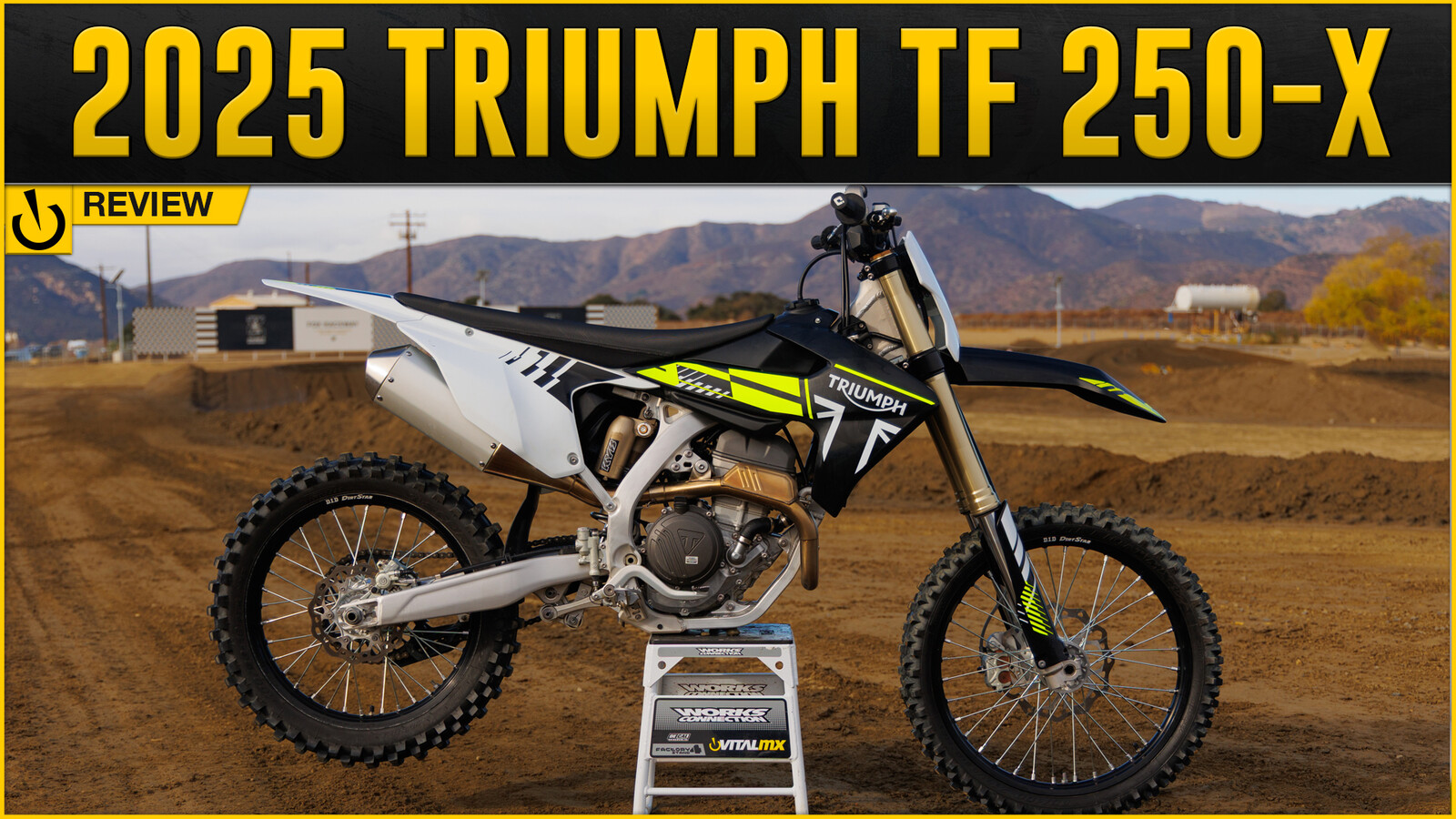
For 2025, the Triumph TF 250-X enters its second season in the fiercely competitive 250cc four-stroke class with subtle revisions from its debut year. After addressing some minor ECU mapping issues in its first iteration, Triumph has refined the fuel mapping and introduced bold new graphics for the updated model. The TF 250-X is touted to have the best power-to-weight ratio in its class and boasts high-quality components straight from the factory floor.

The bike features KYB's Air-Oil Separate (AOS) 48mm closed-cartridge coil spring fork and a fully adjustable KYB shock. The frame is exclusive to Triumph, offering an aluminum spine design. It's also rounded out with a Brembo hydraulic clutch and brakes, Pirelli Scorpion MX32 tires, Pro Taper Carbon ACF handlebars, D.I.D. DirtStar rims, and machined aluminum hubs. With an MSRP of $9,495, it sits comfrotably in the mid-range of 250Fs.
First Impressions
At first glance, I was actually quite impressed with the Triumph TF 250-X. The sleek black plastics, paired with eye-catching highlight graphics, set it apart from other manufacturers. The chassis has a familiar feel, reminiscent of a 2009 Yamaha YZ, while the engine shares external similarities with KTM’s offerings. However, these are not copies – the design is entirely in-house, designed by Triumph. Another detail that stood out to me was the quality of the hardware, the welds, and just the tiniest machining details. Honestly, it brought a bit more confidence before I even swung a leg over it. Although, I'll admit, the Torx hardware isn't the exciting feature...
Now, what did I think after just a few opening laps? It’s clear that Triumph has poured significant time, effort, and resources into creating a competitive bike from the start. The engine delivery was noticeably strong but linear, and the lightweight chassis felt both stable and responsive. Tossing in the KYB suspension, I felt comfortable pushing my pace after only a few laps at Fox Raceway. Now, let’s dive into more specifics as I spent time aboard this machine.
Engine
Starting off with the most critical factor in the 250F class, the engine. How does the Triumph stack up? Initially, the power delivery reminds me of a hybrid between the Yamaha YZ250F and KTM 250 SX-F. It has strong low-to-mid range power, with a smooth and consistent pull up-top, finishing off with impressive over-rev. While it’s uncommon to use third gear in corners on most 250Fs, the Triumph handles it with ease, requiring little clutch work. The only other 250F I’ve ridden that can do this well is the YZ, which has dominated the class with its low-end torque for years. At Fox Raceway, the engine’s strong low-end power was evident in the ruts and jumps, where it felt solid and predictable. As the bike revs up, the transition through mid to top-end power is smooth, and it doesn’t require the same short-shifting as the YZ. While 250Fs are typically favored by younger riders who love to rev their bikes, the Triumph maintains strong, usable power throughout the RPM range. The exhaust note is refined and pleasant at high revs, unlike some of the rougher-sounding Japanese bikes. One minor critique would be needing a little better throttle to rear wheel connection from 0-10%, as it feels slightly behind the YZ in response. Overall, the Triumph delivers excellent power and a claimed best-in-class power-to-weight ratio, which is hard to dispute after riding it alongside other 250Fs.

The revised mapping for 2025 eliminates some of the hesitation and mid-range dip present in the 2024 model, offering a more linear, smooth ride. Additionally, the Triumph MX Tune Pro App allows users to easily switch between 10 pre-configured maps, ranging from novice to expert levels, including options for specific track conditions like hard pack, loam, sand, and even a map for an Akrapovic exhaust system. This feature is incredibly convenient and saves time on tuning, especially for riders who may not have extensive experience with mapping. So, while it's missing the tune-ability of Yamaha's industry-leading app, the pre-built options are also a nice touch. Little give or take there.
As for the Brembo hydraulic clutch, I actually found it a bit tricky to modulate, particularly when entering corners. The small window between engagement and disengagement made it difficult to manage, and I would personally prefer a cable clutch for more precise control. That said, the engine remains one of the best in the 250F class, and the engineers at Triumph have clearly put in the work to ensure it’s competitive from the start. Hats off to them.
Suspension
Now, let’s talk about suspension – my favorite aspect to tinker with. The KYB suspension out of the box felt a little soft, but the damping was smooth and controlled throughout the stroke. The initial stroke offered plush comfort, handling small and medium bumps with ease. As the track roughened, however, I noticed the bike bottoming out more easily, especially in the mid-to-end stroke. To address this, I stiffened the fork’s compression by four clicks and slowed the rebound by three clicks, making gradual adjustments to fine-tune the feel. These changes improved comfort, helped maintain better front-end control in corners, and provided a more stable feel through rougher sections.
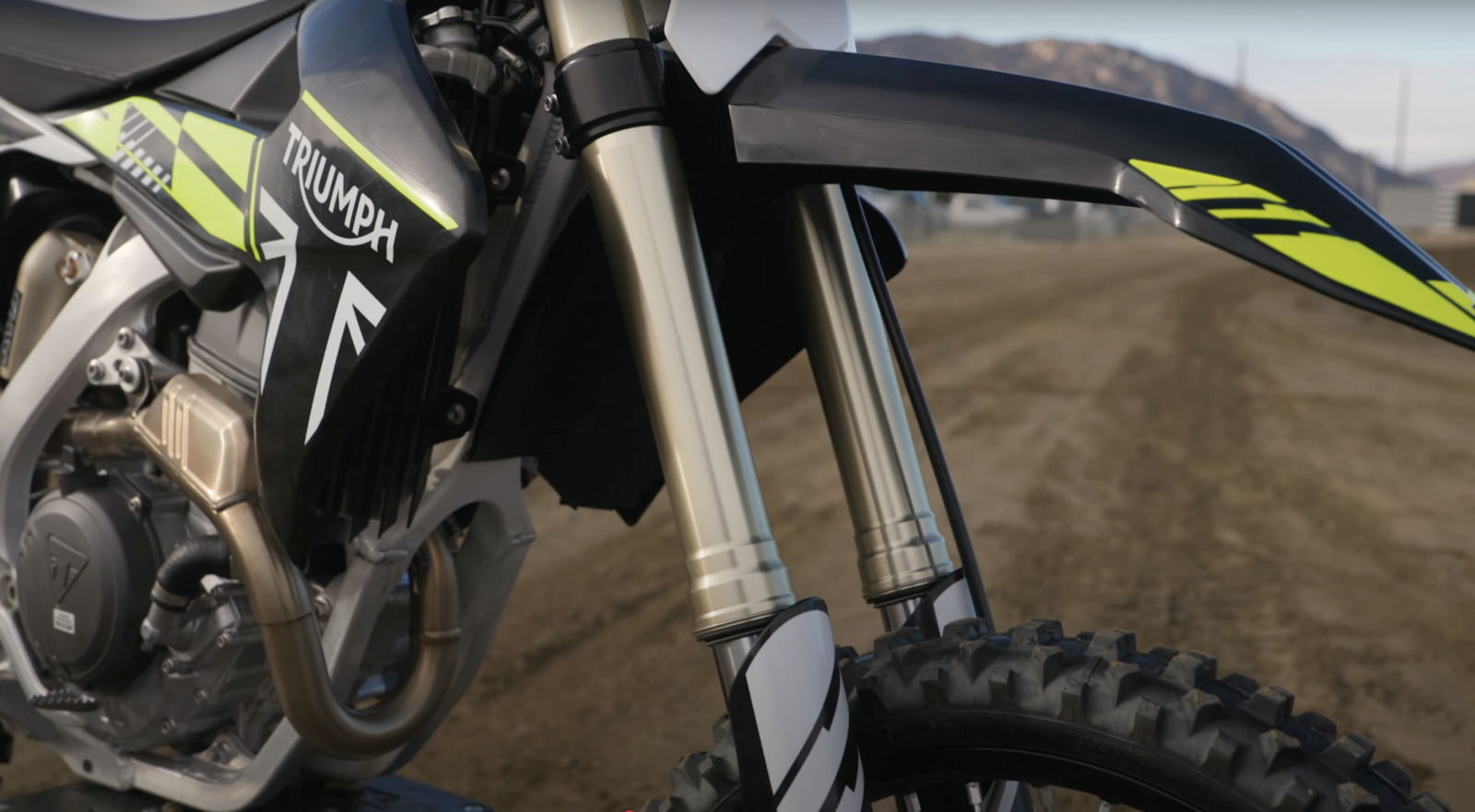
After tackling the forks, I had to stiffen the shock. This was mostly due to the added stiffness in the fork placing more pressure and weight into the rear of the bike, and slightly changing the balance. To do so, I increased high-speed compression by a 1/4 of a turn, which really helped absorb big bumps and improved hold-up on jump faces. I then adjusted low-speed compression by going two clicks stiffer and slowed the rebound two clicks as well. These tweaks were made to help with ride attitude and improved pitching front-to-rear. All this made for a much more level ride overall. For lighter riders, the stock settings may be ideal, but for those pushing the bike harder, adjusting the suspension will be a bit needed.
If I were to spend more time with the bike, the suspension would be my main focus as the more comfortable I got on the Triumph and the harder I pushed, the more performance I wanted from the forks particularly.
Chassis, Ergonomics, and More
As for the chassis and body, Triumph has opted for an aluminum frame design that we haven't seen in a while, looking most similar to a 2009 YZ250F. In a quick opinion, it did offer predictable stability without sacrificing agility. I appreciated the stability when hitting bumps, knowing exactly how the bike would react. The balance between agility and stability inspired confidence from the very first few laps. For me, the bike was calm entering corners in area one, which is the beginning part of the corner and then felt easy to lean and hold at lean in area two (which is the apex of the corner). Exiting the corner or area three, the TF 250-X was easy to stand back up and didn’t need much rider input when accelerating up to a jump or down a straightway. However, under high-load situations like hard jump landings or rough sections at speed, the chassis felt slightly harsh and lost a bit of comfort. This did cost me a bit of confidence when really pushing and sending high-load sections of the track. I suspect the front end feels a bit less rigid than the rear, which could be addressed with different engine mounts, or potentially triple clamps. That said, the chassis’ overall performance is impressive for a manufacturer on their first motocross bike.

The bodywork is sleek, with well-designed shrouds and number plates that don’t interfere with rider movement. Honestly, there's always a concern with a new bike or an OEM without much motocross experience. That concern is how will I feel on the bike, will it feel natural to ride? The rider triangle feels natural and comfortable, especially for my 5’10”, 170-pound frame.
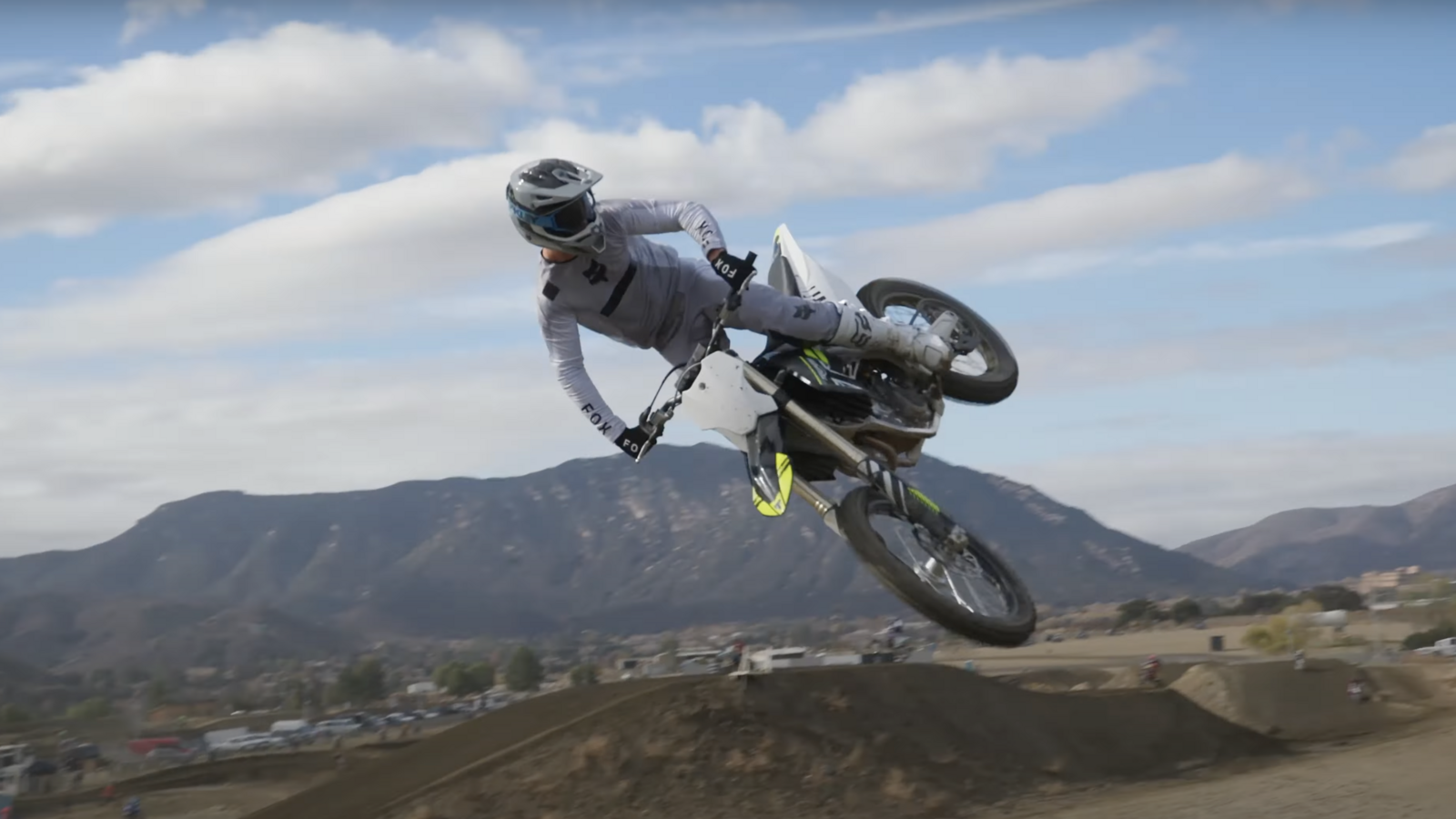
I do have a stand-out gripe, the Pirelli Scorpion MX32 mid-soft tires. While they save weight, I found their soft carcass prone to folding under load, especially on harder-packed tracks. This instability can be felt, particularly on jump faces, and their traction isn’t as good as other tires I’ve used. But this is an easy fix and doesn’t detract from the overall performance. It's just something I would personally fix early into ownership. What else stands out? The Torx hardware is a major departure from anything else in the class, particularly in the US market. Also, the electronic suite of controls just looks and feels a little last minute. Considering how well laid out the rest of the bike is and the quality of every other part, the cluster on the bar seemed like a bit of an afterthought. It's not terrible, it could just be better.
Closing
In conclusion, I was thoroughly impressed with the Triumph TF 250-X. With a powerful engine, top-tier suspension parts, stable chassis, and high-quality components, it’s clear Triumph is serious about competing in the motocross world. The bike's mostly positive reception proves that even more. Triumph’s commitment to hiring industry veterans shines through, and it will be exciting to see how they continue to innovate with future models. Given how well the 250-X performs straight out of the gate, I’m eagerly looking forward to swinging a leg over their 450F model. The future of motocross looks bright with more manufacturers entering the fold and pushing the sport forward. See you at the track!
Review by Steven Tokarski / Video by David Schlapkohl
2/26/2025 3:22pm
0 comments
To post, please join, log in or connect to Vital using your Facebook profile Login with Facebook.